
Landscape guide · Brentwood, Franklin and Williamson County, TN
Sloped Backyard Ideas for Brentwood and Franklin, TN: 6 Ways to Use Every Foot
Terraces, steps, plantings and drainage that turn a hill into yard you can use, with what each idea costs and how to pick the right one for your slope.
Quick answer
The best sloped backyard ideas level the ground you want to use and calm the water on the rest. That usually means a terrace or retaining wall, steps or a path, hardy plantings and a drainage plan. Retaining walls cost $20 to $53 per square foot of wall face nationally [3]. Pineda prices each yard after a free site visit.
What are the best ideas for a sloped backyard?
Six ideas cover almost every sloped yard: tiers, a retaining wall, steps, a winding path, ground cover and a dry creek bed. A popular national roundup lists the same ones, along with a waterfall, a fire pit, veggie beds and a play area [2].
Many yards in Brentwood and Franklin slope. You do not have to flatten the whole lot. Pick the part of the yard you want to use, level that part, and handle the rest with plants and water control.
Tiers and terraces
Break the hill into flat steps that hold a patio, a bed or a lawn.
Retaining wall
Hold the slope back so you get one large level area.
Steps
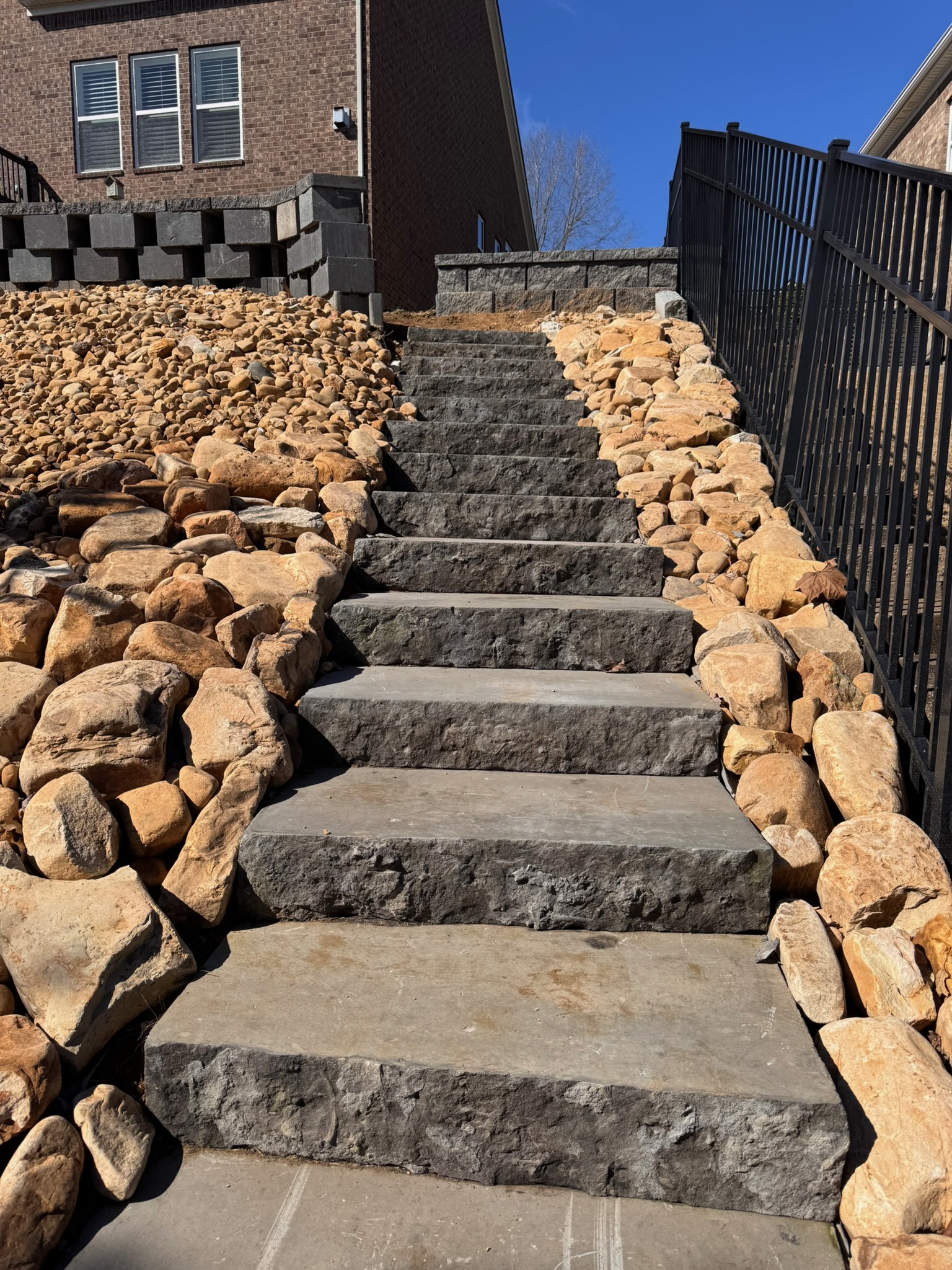
Stone steps give you a safe way up and down.
Winding path
A curved path softens a steep run and links the levels.
Ground cover
Low plants hold soil where grass is hard to mow.
Dry creek bed
A rock channel that carries rain downhill and looks like a garden feature.
The sections below show how each one works and what it costs.
Terraces and retaining walls: make flat ground on a hill
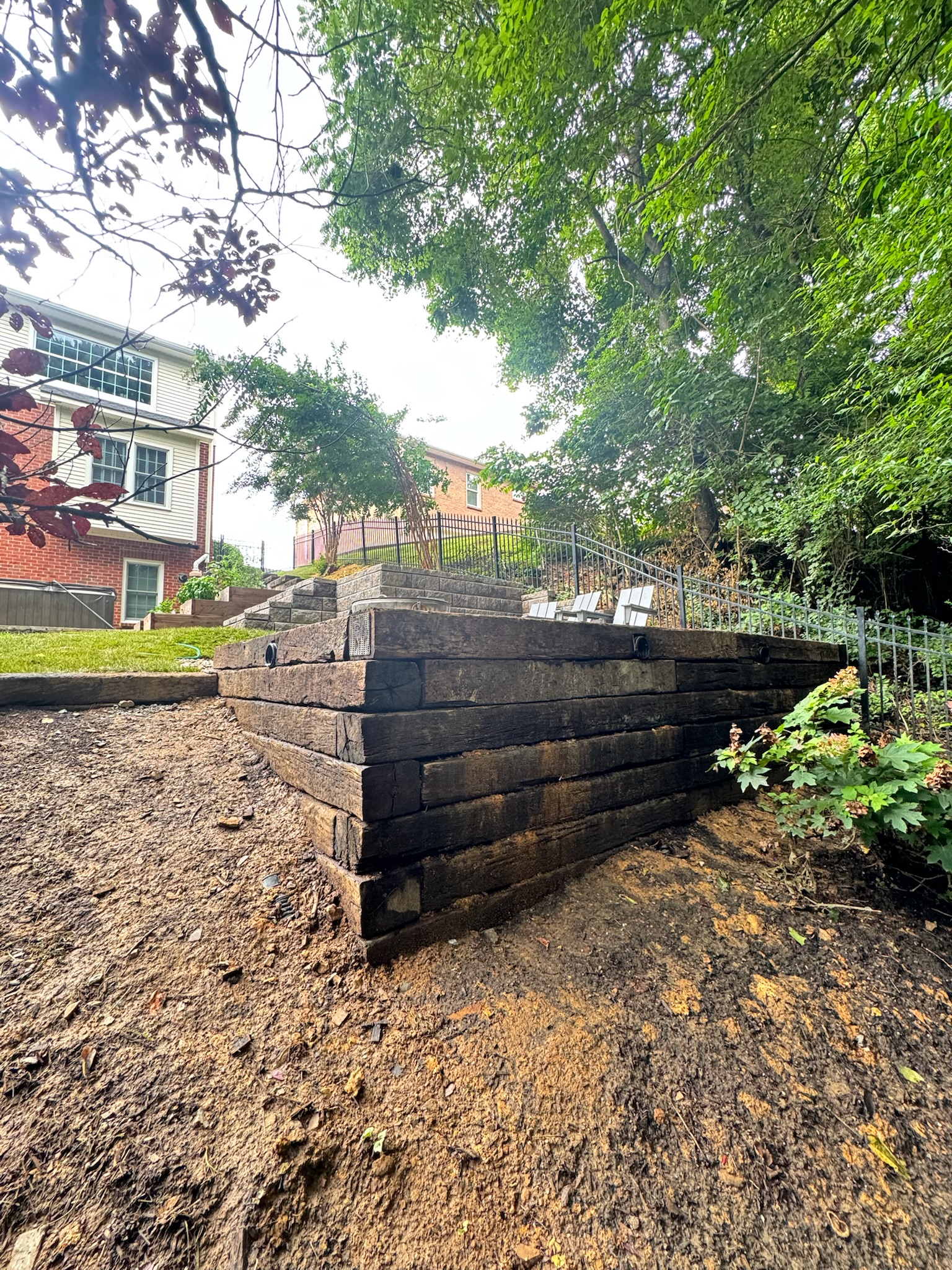
A retaining wall makes level ground by holding the hill back. Iowa State University Extension says you can create flat areas on a slope with retaining walls, boulders, field stones, bricks or wooden timbers [1].
The same source says terracing can be as simple as a path carved into the slope to slow water [1]. A full terrace uses a wall at each step.
Walls cost about $20 to $53 per square foot of face nationally, and walls on a slope run about $40 to $200 per linear foot [3]. Our full retaining wall cost guide has prices by material and size.

On a steep lot, two or three shorter walls can keep each wall under the height lines above. Ask your estimator to price both.
Steps and paths on a slope: a safe way up and down
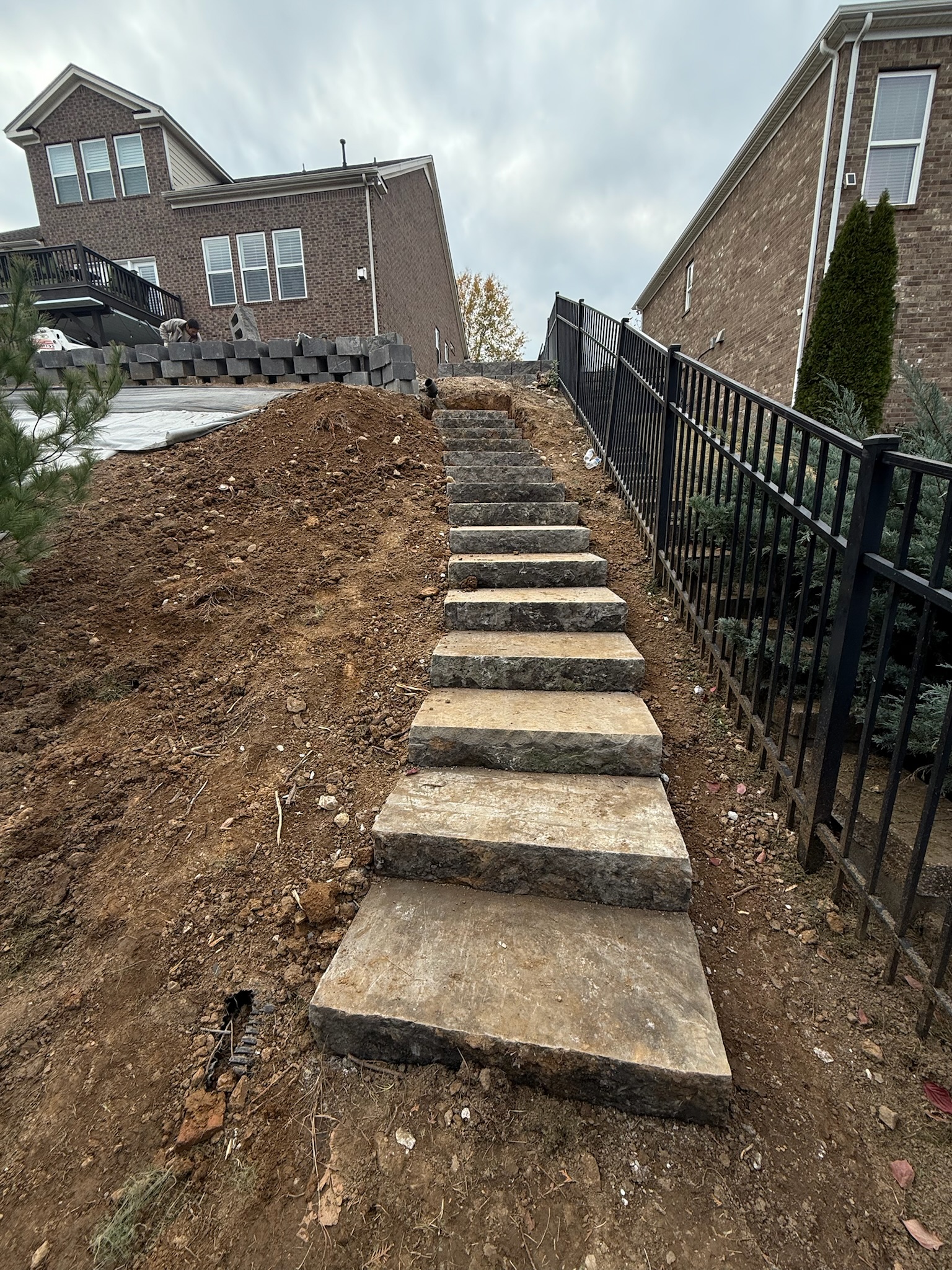
Steps and paths turn a slope you avoid into a yard you walk through. Stone steps and a winding path are two of the 12 ideas in Bob Vila’s sloped backyard guide [2].
Build steps into the hill, not on top of it. The crew cuts a level bed for each tread, sets a gravel base and locks the stone in place. Each step needs the same rise so nobody trips.
A path that curves across the slope is easier on the legs than one that runs straight up. Edge it with stone or steel so soil does not wash onto it.
Read how we build them on our walkways and pathways page.
What to plant on a slope: ground cover, shrubs and contour beds
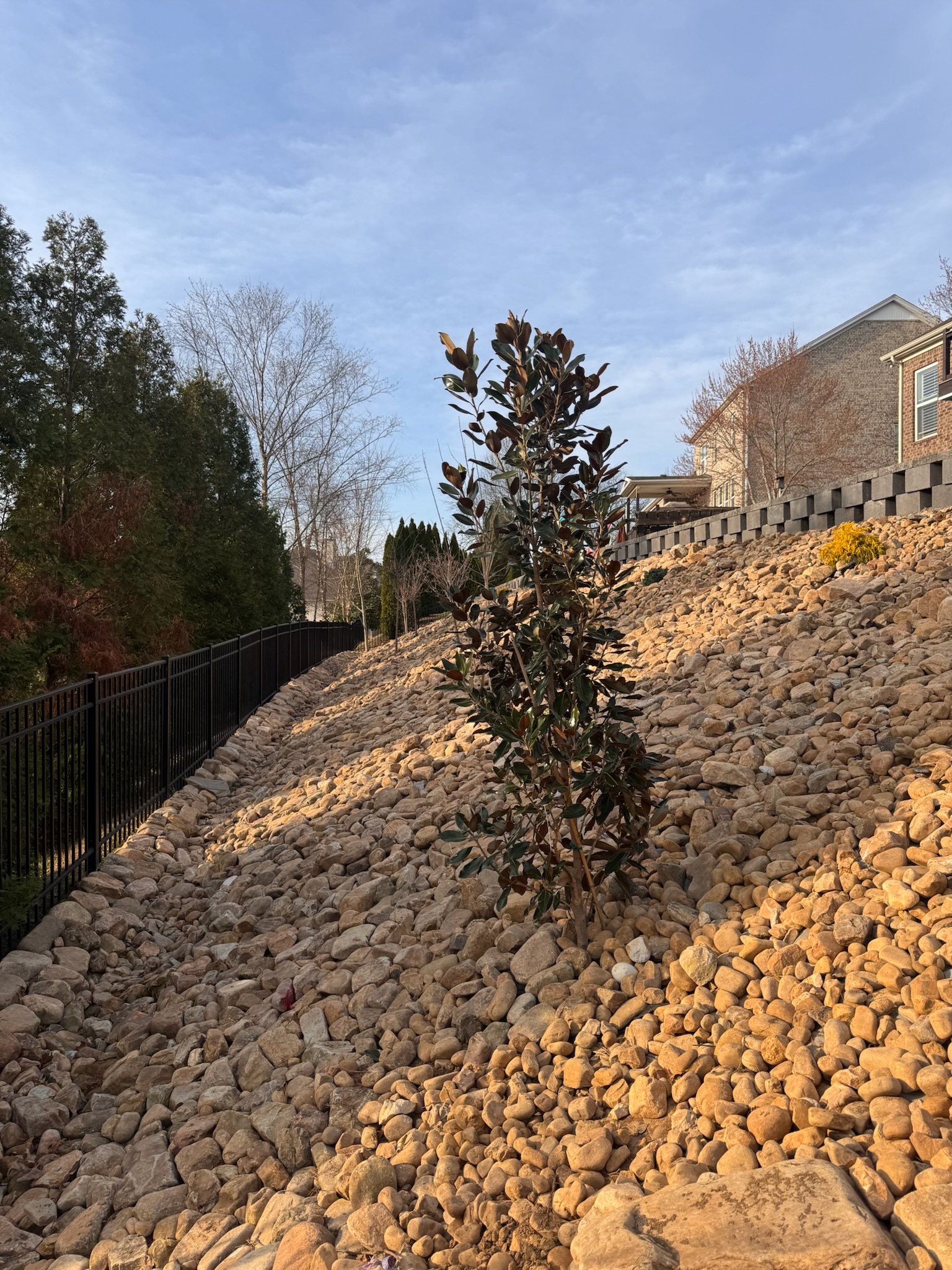
Plantings protect a slope that is too steep to mow. Iowa State University Extension says slopes of about 30 percent or more are too steep to mow, so you need plantings other than turfgrass [1].
Ground covers work well because they cover the soil surface [1]. Plant them in rows along the slope’s contour lines, which slows water and cuts erosion [1].
On a slope, bare soil is the problem. Cover it with plants, stone or mulch and the rain stops carrying it downhill.
Timing matters in Middle Tennessee. The average last spring freeze is March 31, and the average first fall freeze is November 3 [8]. Plan to have new roots in before heavy rain. Our Middle Tennessee planting calendar shows what to plant each month in zone 7b.
For design help, see our landscape design and installation page.
A dry creek bed that carries water down the hill
A dry creek bed is a channel of river rock that guides rain downhill. Bob Vila lists it as a way to mitigate drainage issues on a slope [2].
A small one is a low-cost fix. Fixr says most homeowners pay around $600 for a 20 square foot dry river bed of pea gravel and mixed river stones, and river rock runs $80 to $280 per ton [6]. A longer or wider channel with boulders costs more.
Use it for surface water that has a clear path. If water soaks the ground and stays, you may need a French drain instead. Read French drain vs surface drain to choose.
How steep is your slope, and which idea fits?
Steeper slopes need walls and steps, and gentler slopes can take lawn or a few plants. Measure first, then match the idea to the number.
Here is a simple way to measure:
- Set two stakes. Put one at the top and one at the bottom, in a straight line down the hill.
- Run a level string. Tie a string to the top stake and hold it level over the bottom stake.
- Measure the drop. That is the rise in inches from the string down to the ground at the lower stake.
- Measure the distance. That is the run, from stake to stake in inches.
- Divide rise by run. Multiply by 100 for percent. A 12 inch drop over 36 inches is about 33 percent.
| What you see | Good ideas | Why |
|---|---|---|
| Gentle slope, under 30 percent, mowable | Lawn, planted beds, a path, a dry creek bed | Lawn is still practical below about 30 percent [1] |
| About 30 percent or more | Ground cover, shrubs, mulch, steps | Too steep to mow, so use plantings other than turfgrass [1] |
| You want a flat patio, fire pit or play area | Retaining wall plus a level pad | Walls create flat areas on a slope [1] |
| Water runs across the yard after rain | Dry creek bed, French drain, gravel-backed wall | Move water before it undermines the slope |
| Tall drop of 4 feet or more in one place | Two or three shorter tiers | Shorter walls are easier to build and may stay inside city height limits [7] |
What sloped backyard landscaping costs
Cost depends on the idea. A dry creek bed can run in the hundreds of dollars, while a long wall runs into thousands. These are national numbers and not Pineda prices.
| Work | National range |
|---|---|
| Retaining wall, per square foot of face | $20–$53, average $33 [3] |
| Retaining wall on a slope, per linear foot | $40–$200 [3] |
| Land grading, per square foot (2022 figure) | $0.40–$2 [5] |
| Waterproofing a wall, per square foot | $2–$10 [3] |
| Dry river bed, about 20 square feet | About $600 [6] |
| River rock, per ton | $80–$280 [6] |
| Adding drainage by excavation, per linear foot | Up to $60–$70 [4] |
Sources: LawnStarter (Oct 2026), Bob Vila (2022), Fixr (Jan 2025). National figures, not Pineda prices. Pineda prices each project after a free site visit.
Step and path costs vary with stone, width and number of steps, so we do not list a national figure here. Your estimator measures them on site.
Slope projects often need regrading and prep work first [4]. That is part of why a hillside quote can sit above the middle of a national range.
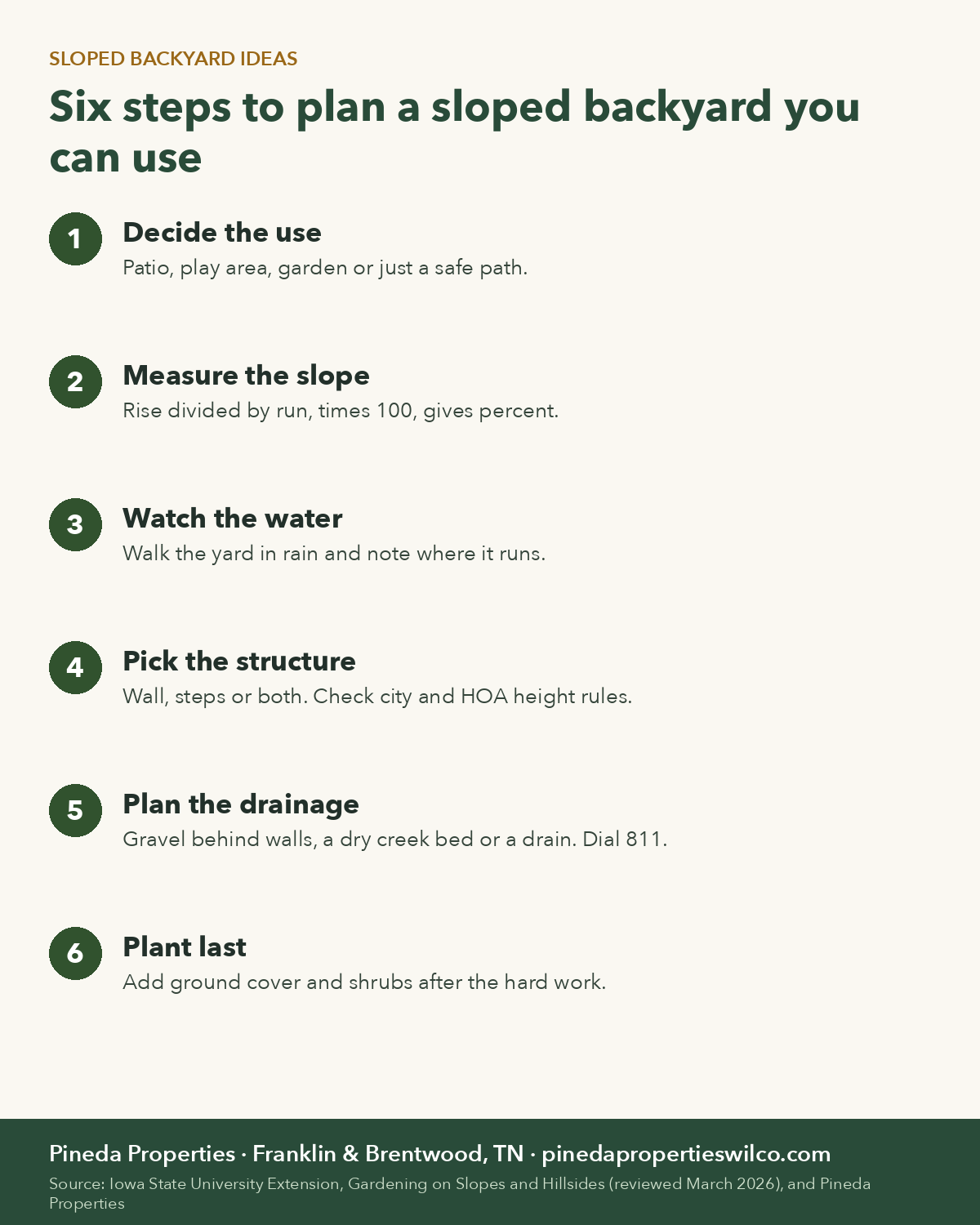
How to plan a sloped yard project, step by step
Start with how you want to use the yard, then work out the wall, the water and the plants in that order.
- Decide what you want. A patio, a play area, a garden or just a safe path.
- Measure your slope. Use the stake and string method above.
- Watch the water. Walk the yard in a rain. Note where it runs and where it pools.
- Pick the main structure. A wall, steps or both. Ask about height limits and HOA rules.
- Plan the drainage. Gravel behind walls, a dry creek bed or a drain where water collects. Dial 811 before digging.
- Add plants last. Plant ground cover and shrubs after the hard work, timed to the freeze dates.
Want the whole yard planned in one project? See our backyard makeovers and retaining wall installation in Franklin. Live in Brentwood? We work there too.
Get a sloped backyard plan built for your yard
Pineda Properties designs and builds terraces, retaining walls, steps and drainage across Franklin, Brentwood, Spring Hill, Nolensville, Thompson’s Station, College Grove, Fairview and Nashville. Pineda prices each project after a free site visit.
Get my free estimate Call (615) 899-5766Sloped backyard questions from Brentwood and Franklin homeowners
What is the best way to landscape a sloped backyard?
Level the part you want to use with a retaining wall or terrace, add steps or a path, and cover the rest with plants. Add drainage so rain does not wash the slope away. Most good designs combine two or three of these.
How do I stop erosion on a slope?
Cover bare soil with ground cover, shrubs, mulch or stone. Iowa State University Extension says planting along the contour lines of a slope can slow water and reduce erosion. A terrace or a dry creek bed also slows water.
How steep is too steep to mow?
Iowa State University Extension says slopes of about 30 percent or more are too steep to mow. That is roughly 1 foot of drop for every 3 feet across. Use ground cover or other plantings there instead of turfgrass.
How much does it cost to terrace a sloped yard?
Retaining walls cost about $20 to $53 per square foot of wall face nationally, and walls on a slope run about $40 to $200 per linear foot. A terrace uses one wall per level. Pineda prices each yard after a free site visit.
Can I use a retaining wall on my slope without a permit in Franklin?
Franklin’s zoning ordinance limits residential retaining walls to 2 feet in a front yard and 6 feet in a side or rear yard. Permit rules can differ by project, so ask City of Franklin Building and Neighborhood Services. Your HOA may also review the design.
What is a dry creek bed and does it help drainage?
A dry creek bed is a channel of river rock that guides rain downhill. It works for surface water that follows a clear path. A national estimate is about $600 for a 20 square foot dry river bed, and river rock runs $80 to $280 per ton.
Sources
- Iowa State University Extension, “Gardening on Slopes and Hillsides”, last reviewed March 2026
- Bob Vila, “12 Lush Landscaping Ideas for a Hilly Backyard”
- LawnStarter, “How Much Does a Retaining Wall Cost in 2026?”, updated October 5, 2026
- Fixr, “Retaining Wall Cost”, updated January 31, 2025
- Bob Vila, “Retaining Wall Cost”, updated July 6, 2022
- Fixr, “Cost of Landscaping Stones”, updated January 31, 2025
- City of Franklin, Tennessee, Zoning Ordinance, retaining wall height limits, effective January 13, 2026
- NOAA NCEI U.S. Climate Normals 1991–2020, Nashville International Airport