
Hardscaping guide · Franklin and Williamson County, TN
Paver Patio Cost in Franklin, TN: Real Prices From 37 Local Quotes
What homeowners here really spend, what each square foot costs by material, and how to get a quote you can trust.
Quick answer
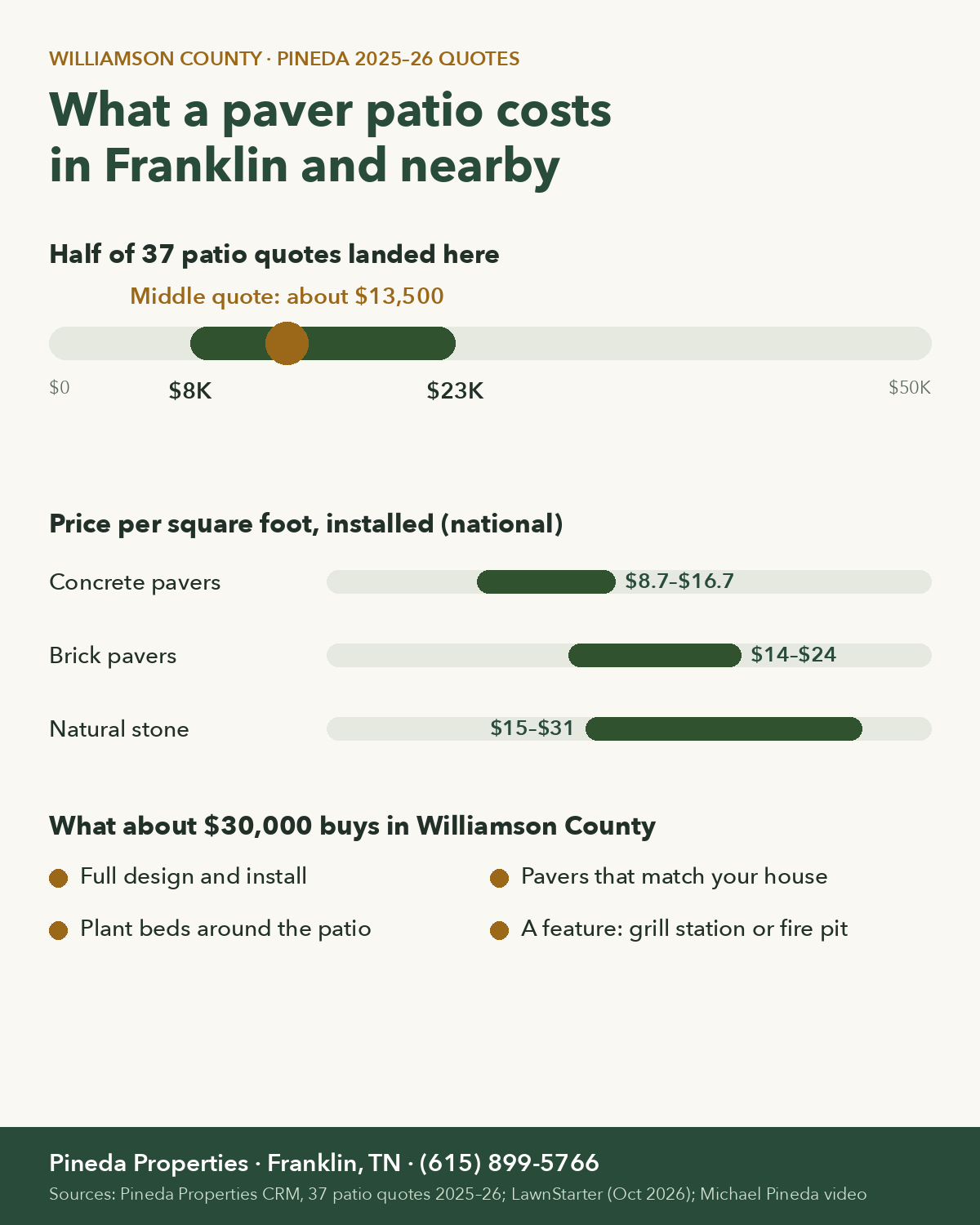
A paver patio project in Franklin and Williamson County often costs about $8,000 to $23,000. Half of the 37 patio quotes Pineda Properties gave in 2025–26 fell in that range, and the middle quote was about $13,500 [1]. National guides put installed concrete pavers at $8.70 to $16.70 per square foot and natural stone at up to $31 [2].
What a paver patio costs in Franklin and Williamson County
Half of the patio projects Pineda Properties quoted in 2025–26 came in between about $8,000 and $23,000. The middle quote was about $13,500 [1].
These numbers come from 37 real patio quotes in our own records, rounded. They are not a national average. They are what local homeowners asked us to price for their own yards.
National cost pages mostly show a price per square foot and stop there. A real quote prices your whole project. That can include the base, borders, steps, drainage and features such as a seating wall or a fire pit.
Source: Pineda Properties CRM, 37 patio quotes, 2025–2026, rounded [1].
Use the range as a planning number. Your own price depends on the size of the patio, the paver you pick and what is under the ground. The sections below show how each one moves the price.
Paver patio cost per square foot, by material
Installed concrete pavers cost about $8.70 to $16.70 per square foot nationally. Brick runs $14 to $24, and natural stone runs $15 to $31 [2].
“Installed” means materials and labor together. Another national guide puts most paver patios at $8 to $25 per square foot, depending on the material [3].
| Material | Installed cost per sq ft (national) | Good fit for |
|---|---|---|
| Concrete pavers | $8.70–$16.70 [2] | Most patios. Many colors and shapes, easy to match to the house. |
| Brick pavers | $14–$24 [2] | Classic and traditional homes. Warm, uniform color. |
| Natural stone | $15–$31 [2] | A one-of-a-kind look. Each stone is different. |
| Pavers, all materials | $8–$25 [3] | A second national check on the same range. |
Source: LawnStarter national patio pricing guide, updated October 5, 2026 [2]. Bar length shows the top of each range. Prices are installed, per square foot.
The paver itself is only part of the price per square foot. Labor, the gravel base and edging are in that number too. That is why two patios with the same paver can still get very different quotes.
Torn between pavers and stone? Our guide to paver vs natural stone patios compares the look, feel and upkeep.
Paver patio cost by size: 12×12, 16×20 and 20×30 feet
At national prices, a 12×12 concrete paver patio costs about $1,250 to $2,400. A 20×30 natural stone patio can reach about $18,600 [2].
We worked out the table below by multiplying each size by the national per-square-foot ranges. It covers the patio surface only. Features, steps, walls and extra base work are not in it.
| Patio size | Area | Concrete pavers | Brick | Natural stone |
|---|---|---|---|---|
| 12×12 ft (bistro table, small grill) | 144 sq ft | $1,250–$2,400 | $2,000–$3,450 | $2,150–$4,450 |
| 16×20 ft (dining set plus a few chairs) | 320 sq ft | $2,800–$5,350 | $4,500–$7,700 | $4,800–$9,900 |
| 20×30 ft (dining and lounge areas) | 600 sq ft | $5,200–$10,000 | $8,400–$14,400 | $9,000–$18,600 |
National ranges: size × LawnStarter installed cost per square foot [2]. Not a Pineda price. Rounded to the nearest $50.
Compare that with the local quotes. The middle Pineda quote, about $13,500 [1], sits inside the national range for a 20×30 brick patio. A full project with features prices more like a large patio than a small slab.
What $30,000 gets you in Williamson County
In Williamson County, about $30,000 covers a complete backyard project: full design and install, plant beds, pavers that match the house, and a hardscape feature such as a grill station or a fire pit [6].
In this 22-second video, Michael Pineda stands on a finished patio and walks you through what that budget buys.
What the video shows:
- Full design and install. One plan for the whole space, from layout to install.
- Plant beds. Planting around the patio so it looks finished, not dropped in.
- Pavers that match the house. Colors and textures picked to suit your home.
- A hardscape feature. A grill station or a fire pit, so the patio becomes a place to gather.
See our fire pits and outdoor kitchens pages for feature ideas.
What drives paver patio installation cost
Size and paver type set the starting price. The ground under the patio and the extras you add decide the rest.
Size
More square feet means more pavers, more base and more labor.
Paver type
Concrete pavers cost the least per square foot. Brick and natural stone cost more [2].
Base depth
Soft or wet ground needs a deeper gravel base. More gravel means more digging, hauling and compacting.
Slope and steps
A sloped yard may need grading, steps or a retaining wall to make a flat patio.
Access
Tight side yards and fences can slow machines and crews. Easy access saves time.
Demolition
An old concrete slab must be broken up and hauled away before new work starts.
Drainage
Water that pools near the patio or the house must have a place to go. Drainage work protects the patio and the foundation.
Borders and patterns
Contrast borders, curves and detailed patterns take more cuts and more time.
Features
Seating walls, fire pits, outdoor kitchens and lighting turn a patio into an outdoor room.
HOA design review
Some neighborhoods review plans first. The review adds time before work can start.
The pavers are the part you see. The base under them is the part that decides how long your patio lasts.
A strong base on clay soil keeps your patio flat
A paver patio needs a compacted gravel base, commonly 4 to 6 inches deep under a walking patio, plus about 1 inch of bedding sand [4]. Clay soil and wet spots often need more.
The base is the layer you never see after the job is done. It spreads the weight of people and furniture. It also lets water drain away instead of sitting under the pavers.
How the layers stack up
- Dig out the soil. The crew removes grass and soil to make room for the base and pavers.
- Add and compact the gravel base. Gravel goes down in layers, and each layer is compacted, commonly to 4 to 6 inches for a walking patio [4].
- Screed the bedding sand. About 1 inch of sand gives the pavers a smooth, level bed [4].
- Lay and lock the pavers. Pavers go down in the chosen pattern, with an edge restraint to hold them in place.
When the ground under a patio stays wet, a shallow base has less support. That is why base depth and drainage belong in the same conversation.
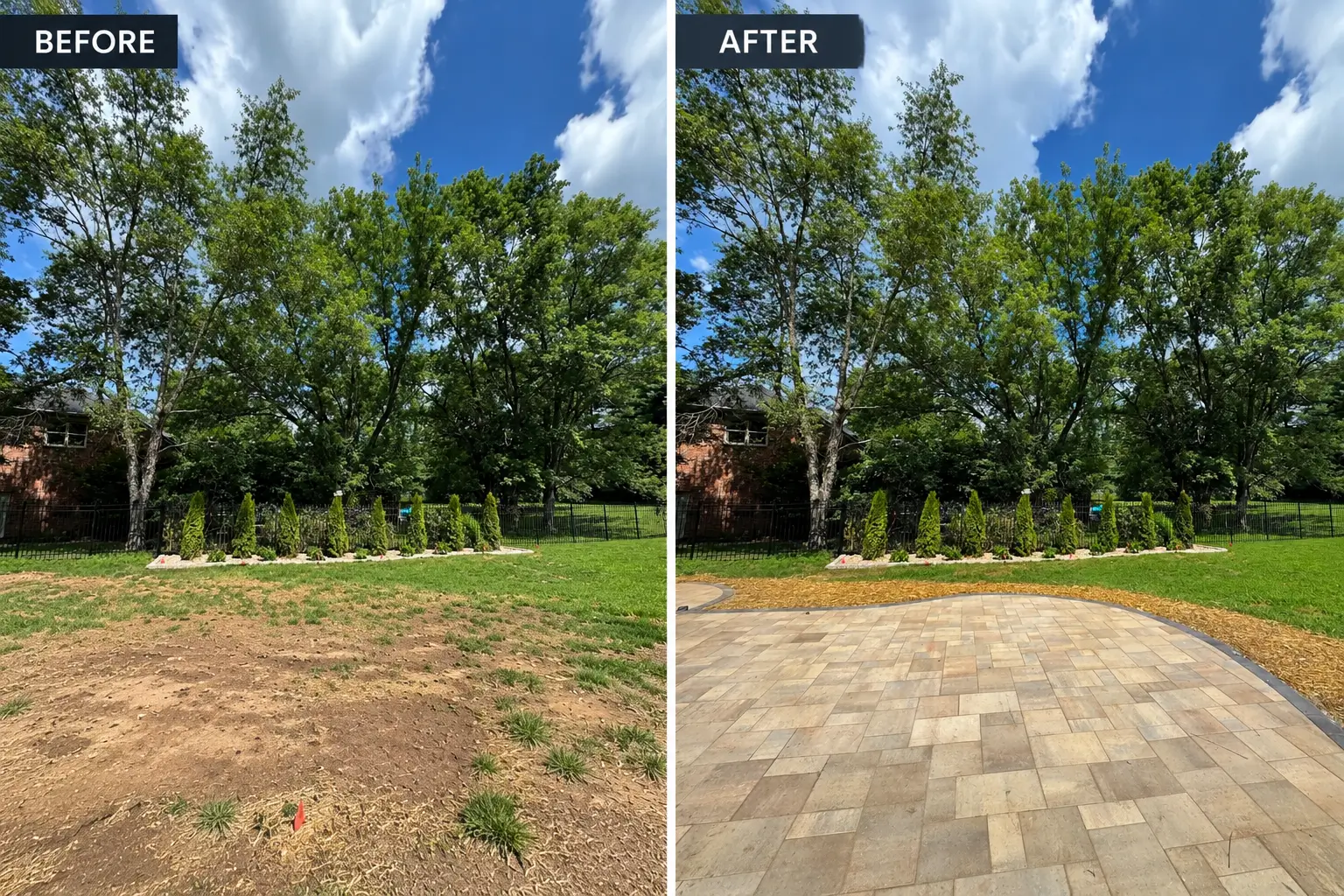
Check your HOA and the City of Franklin before you build
Before you build, check with your HOA and, inside city limits, with the City of Franklin. The city’s zoning code sets rules that can affect a backyard project [5].
The Franklin zoning ordinance took effect January 13, 2026 [5]. In some districts it sets a minimum landscape surface area. It also places accessory structures at least 5 feet from lot lines [5].
If your neighborhood has an HOA, it may have its own design review. Ask for the rules early, so the review fits into your timeline.
Questions to ask before you sign
- Does my HOA need to approve the patio, the paver color or the features?
- Does a fire pit, grill station or seating wall need its own approval?
- How close to my lot line can I build?
- Does my lot have a landscape surface area rule?
Live outside Franklin city limits? Ask your own city or Williamson County which rules apply to your lot.
How to get an accurate paver patio quote
An accurate quote starts with a visit to your yard. A price given by phone cannot see your slope, soil or access.
- Measure and mark the space. Lay out the patio with a hose or paint. Note the rough length and width.
- Decide how you will use it. Dining, lounging, a fire pit or a grill station. Use sets the size and the features.
- Pick two or three paver options. Ask to see samples next to your house’s brick, stone or siding.
- Ask for an on-site visit. The estimator should check slope, soil, drainage and how a crew will get in.
- Get an itemized quote. It should list base depth, pavers, edging, demolition, drainage and each feature.
- Check HOA and city rules. Start any approval before the work date, so the schedule holds.
- Compare quotes line by line. Match base depth and features before you compare totals.
Want to see a real project from start to finish? Read our Franklin paver patio case study.
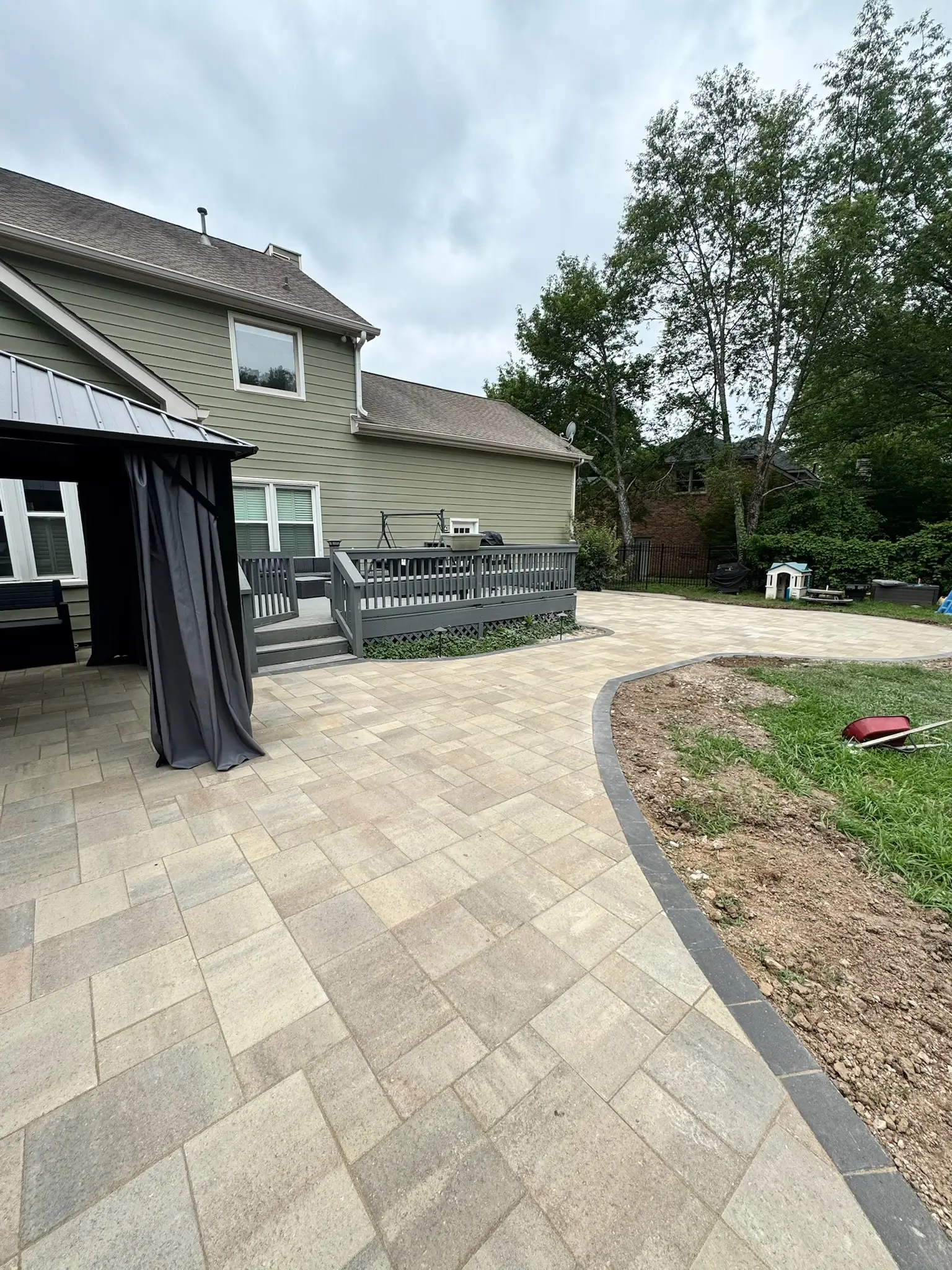
Get a paver patio quote built for your yard
Pineda Properties designs and builds paver patios across Franklin, Brentwood, Spring Hill, Nolensville, Thompson’s Station, College Grove, Fairview and Nashville. Rated 4.8 on Google by 67 homeowners [7].
Get my free patio estimate Call (615) 899-5766Paver patio cost questions from Williamson County homeowners
How much does a paver patio cost in Franklin, TN?
Half of the 37 patio projects Pineda Properties quoted in 2025–26 came in between about $8,000 and $23,000. The middle quote was about $13,500. Your price depends on size, paver type, base work and features.
How much does a 10×10 paver patio cost?
A 10×10 patio is 100 square feet. At national installed prices, that is about $870 to $1,670 in concrete pavers, $1,400 to $2,400 in brick and $1,500 to $3,100 in natural stone. Base work, edging and features can add to it.
How much should a 12×12 paver patio cost?
A 12×12 patio is 144 square feet. At national installed prices, it costs about $1,250 to $2,400 in concrete pavers, $2,000 to $3,450 in brick and $2,150 to $4,450 in natural stone. A local, on-site quote gives you the real number for your yard.
How much does a 1,000 sq ft paver patio cost?
At national installed prices, 1,000 square feet of concrete pavers costs about $8,700 to $16,700. Brick runs about $14,000 to $24,000, and natural stone about $15,000 to $31,000. A patio that size often also needs grading, drainage or steps.
How deep should the gravel base be under a paver patio?
Industry guidance calls for a compacted gravel base, commonly 4 to 6 inches under a walking patio, plus about 1 inch of bedding sand. Clay soil and wet spots often need a deeper base. Ask each contractor to write the base depth on the quote.
Do I need HOA or city approval for a paver patio in Franklin?
Check with your HOA and, inside city limits, with the City of Franklin before you build. The Franklin zoning ordinance, in effect since January 13, 2026, sets a minimum landscape surface area in some districts and places accessory structures at least 5 feet from lot lines. Your HOA may also review the design.
Sources
- Pineda Properties CRM, 37 patio quotes, 2025–2026 (original data, rounded), published November 2026
- LawnStarter, “Pricing Guide: How Much Does a Patio Cost?”, updated October 5, 2026
- Lawn Love, “How Much Does a Patio Cost in 2026?”, 2026
- Interlocking Concrete Pavement Institute (now Concrete Masonry & Hardscapes Association), ICPI-16, “Patio, Sidewalk, Plaza on Compacted Aggregate Base”
- City of Franklin, Tennessee, Zoning Ordinance, effective January 13, 2026
- Pineda Properties, video “What $30K gets you in Williamson County”, Michael Pineda, 2026
- Google reviews, Pineda Properties, Franklin TN, checked November 2026