
Drainage and landscaping guide · Franklin and Brentwood, TN
Dry Creek Bed Landscaping in Franklin and Brentwood: Cost, Design and How to Build One
Move rain away from your house with a river rock channel that looks like part of the garden.
Quick answer
A dry creek bed is a rock-lined channel that carries surface runoff away from your home. Online prices run about $20 to $50 per linear foot installed, and $1,500 to $5,000 or more for a larger bed with boulders and plants [1]. It suits water you can see running across the yard. Soggy ground with nothing flowing needs a French drain.
What is a dry creek bed and how does it fix drainage?
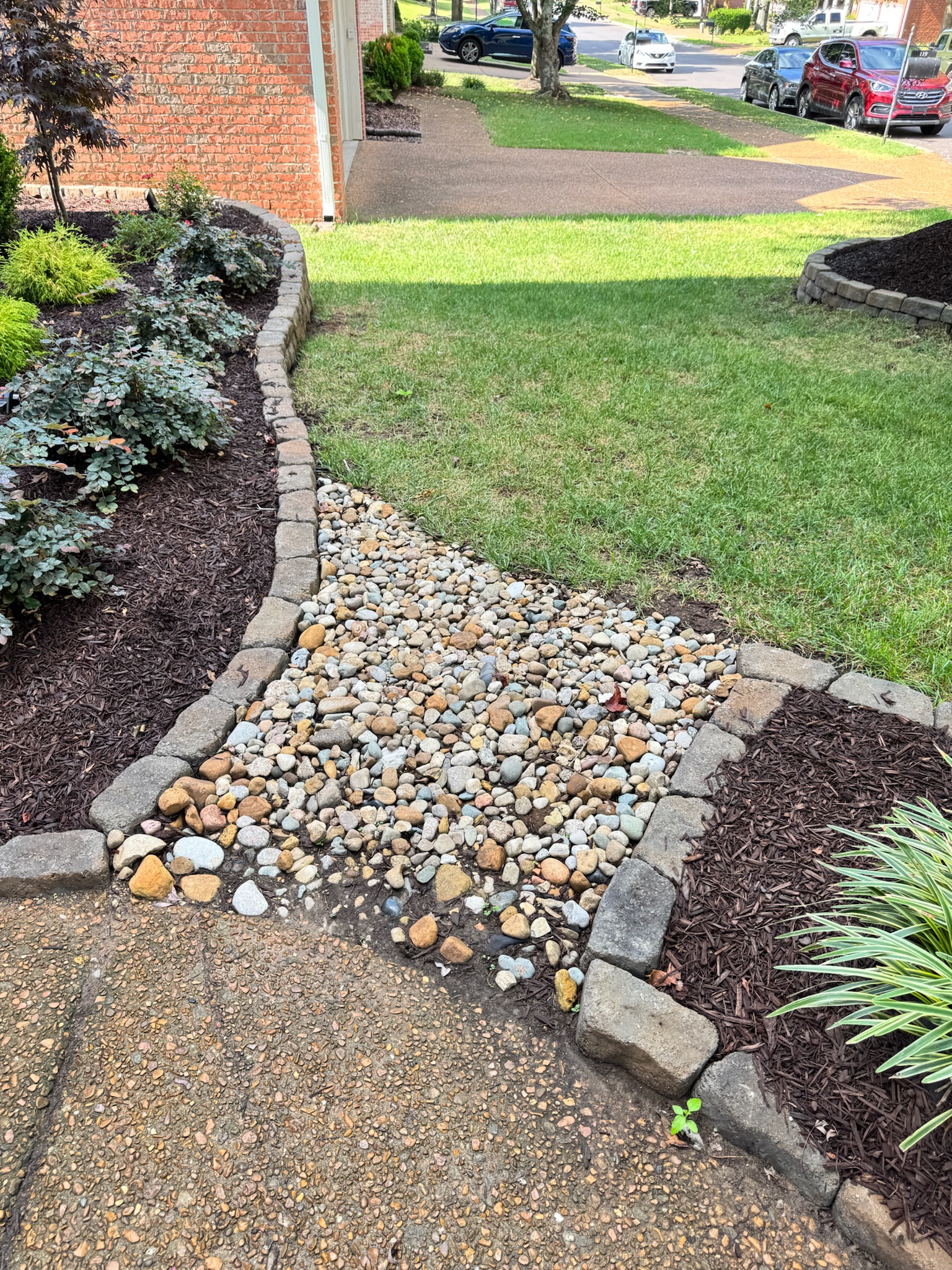
A dry creek bed is a stone-lined channel that looks like a natural watercourse [5]. It can reduce erosion where runoff is a problem and correct a drainage problem or channel storm runoff [5].
Most days it sits dry. When it rains, water follows the channel to a safe spot, and the rocks slow it down.
That is why it works as both a drain and a design feature. You get a path for the water and a rock feature that suits a garden bed, a side yard or a slope.
Will a dry creek bed work in your Franklin or Brentwood yard?
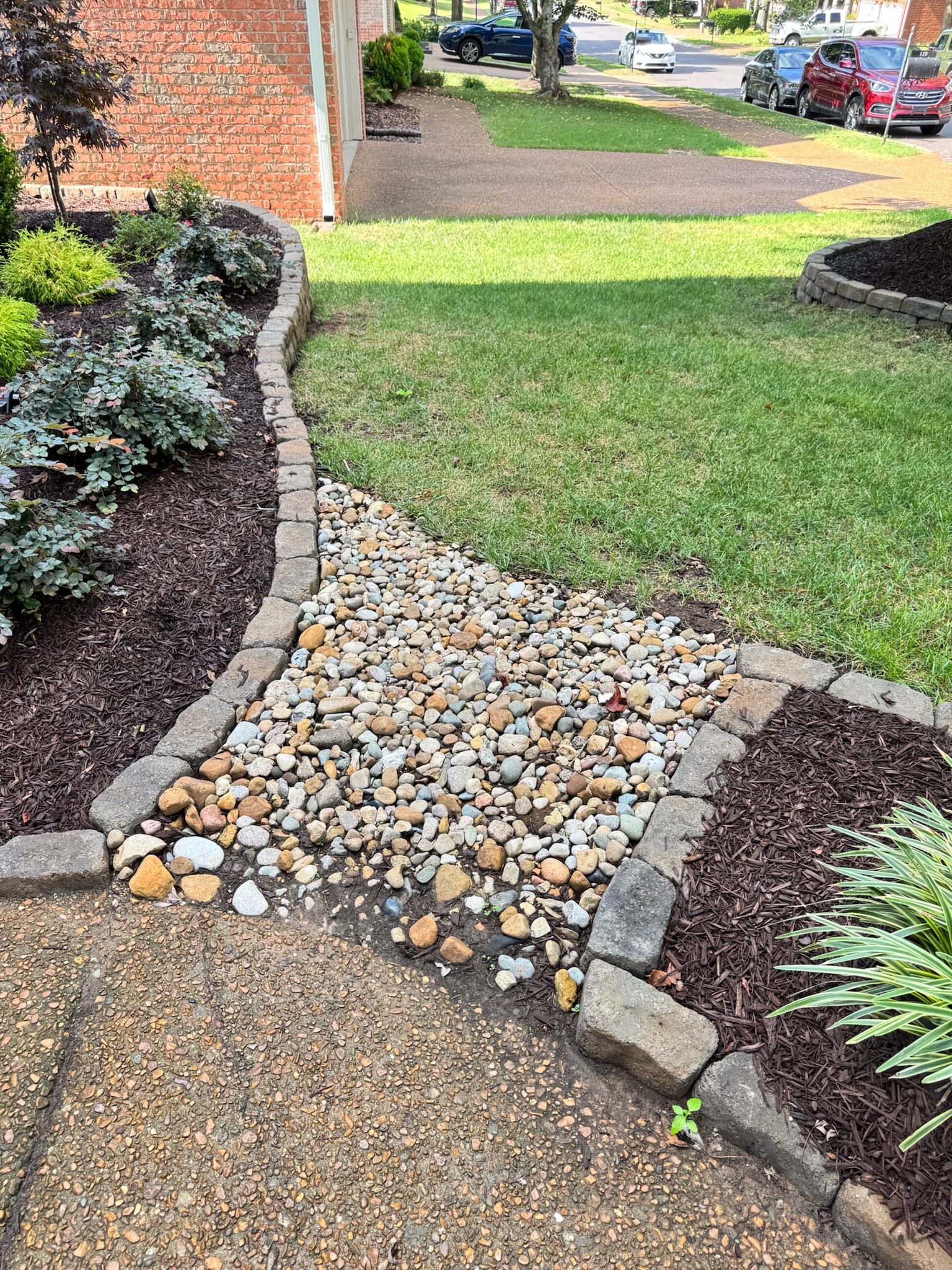
It works when water runs across the surface. It does not work on ground that stays soggy with nothing flowing, and it does not work on dead-flat ground with no outlet [1].
Our weather makes the surface case common. The Nashville area averages 50.51 inches of rain a year, and about 13.6 days a year bring an inch or more [7]. Heavy clay soil is common across Middle Tennessee, so water that cannot soak in runs across the surface.
| What you see | Best fit |
|---|---|
| Water runs across the lawn or a slope after rain | Dry creek bed [1] |
| A downspout dumps water next to the house | Dry creek bed from the downspout to a safe outlet [1] |
| The ground stays soggy but nothing flows on top | French drain [1] |
| Flat yard with nowhere for water to go | Needs a different plan. Ask for a site visit [1] |
How much water comes off your roof?
Every inch of rain on 1,000 square feet of roof sends about 600 gallons your way [8]. That adds up fast on a larger home.
| Roof area | Water in a 1-inch storm |
|---|---|
| 1,500 sq ft | about 900 gallons |
| 2,000 sq ft | about 1,200 gallons |
| 3,000 sq ft | about 1,800 gallons |
Our math: roof area ÷ 1,000 × 600 gallons [8]. Count the roof edge, including the overhang.
A 2,000 square foot roof sheds about 1,200 gallons in one 1-inch storm. That happens about 14 times a year here [7]. Plan the channel for those days, not for a light shower.
How much does a dry creek bed cost?
Online guides put a professionally installed dry creek bed at $20 to $50 per linear foot, or $1,500 to $5,000 or more for a larger bed with boulders and plants [1]. Prices vary widely by source, so treat them as planning numbers.
These are typical market ranges from national and out-of-state guides. They are not Pineda prices. Pineda prices each project after a free site visit.
| Source | Per foot or per sq ft | Whole project |
|---|---|---|
| Yard Drainage Fixes | $20–$50 per linear foot [1] | $1,500–$5,000+ for a larger bed [1] |
| Georgian Landscape Design (Georgia) | $50–$150 per linear foot [3] | $1,500–$8,000+ [3] |
| LatestCost | $8–$45 per square foot [4] | $1,500–$9,000 [4] |
Sources: Yard Drainage Fixes (reviewed September 15, 2026), Georgian Landscape Design and LatestCost, 2026 [1][3][4]. Bar length shows the top of each range.
What common lengths cost
The table below multiplies each length by the per-foot ranges above. It shows why quotes differ by source.
| Length | At $20–$50 per foot | At $50–$150 per foot |
|---|---|---|
| 20 ft (one downspout to the lawn) | $400–$1,000 | $1,000–$3,000 |
| 40 ft (side yard run) | $800–$2,000 | $2,000–$6,000 |
| 60 ft (long slope or back-of-lot swale) | $1,200–$3,000 | $3,000–$9,000 |
Length × per-foot ranges from [1] and [3].
What pushes the price up: length, width, rock and boulder choice, design complexity, site preparation and any drainage work tied into it [3]. Basic gravel costs less than decorative river rock or large boulders.
How wide, deep and steep should a dry creek bed be?
Make it about twice as wide as it is deep, with gentle curves, and give it at least a 1% fall [1]. One inch of drop every 8 feet is a useful minimum [1].
Size the channel to the water it must carry. A small job needs a small channel. Heavier runoff needs a wider, deeper one.
| Water source | Width | Depth |
|---|---|---|
| One downspout | 18–24 in [1] | 6–8 in [1] |
| Heavier erosion runoff | 3–4 ft or more [1] | 12–18 in [1] |
A pretty creek bed that does not drain is just a rock garden. The fall and the outlet come first.
A channel that is narrow and deep reads as a ditch and can scour in storms [1]. A wide, shallow one fits the yard and slows the water.
How to build a dry creek bed, step by step
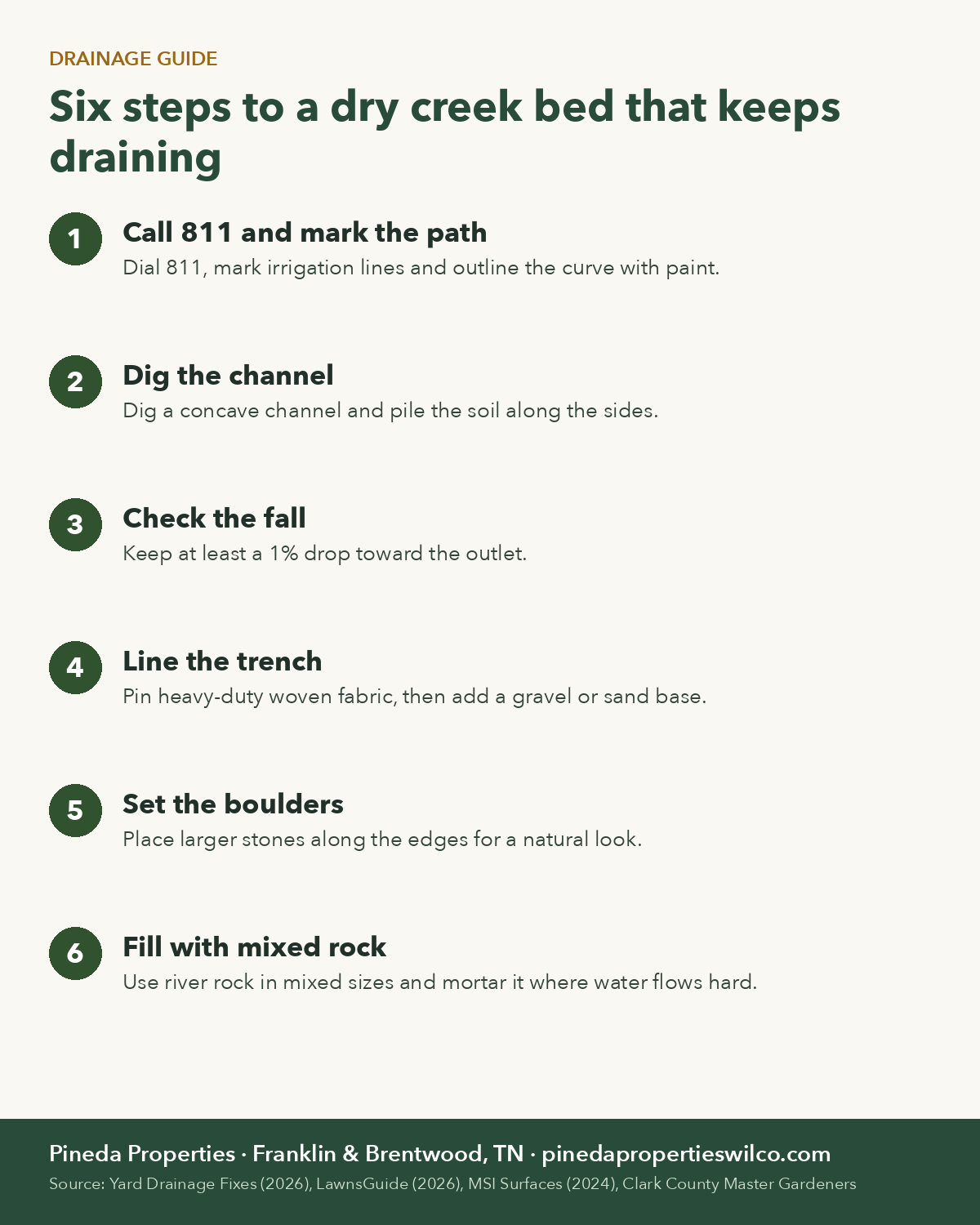
The order is simple. Mark the path, dig, line the trench, set the edge stones and fill with mixed rock. Call 811 before you dig.
- Call 811 and mark the path. Dial 811 so utility lines are marked. Mark irrigation lines too, then outline the curve with paint [6].
- Dig the channel. Dig in a concave shape. One guide calls for 12 to 18 inches for a full-size bed [6]. Pile the soil along the sides to form banks [5].
- Check the fall. Make sure the channel drops toward the outlet, at least 1% [1].
- Line it. Use heavy-duty woven landscape fabric held down with pins [2][6]. Add a base of gravel or coarse sand [6].
- Set the boulders. Place larger stones along the edges, over 10 inches across for a natural look [6].
- Fill with mixed rock. Use river rock of different sizes. One guide uses 3 to 5 inch river rock in the main channel [2].
- Mortar where water flows hard. If the bed carries water, rocks may need mortar to stay put [5].
Dry creek bed or French drain: which one do you need?
Use a dry creek bed for water you can see on the surface. Use a French drain for saturated ground where nothing flows on top [1].
| Feature | Dry creek bed | French drain |
|---|---|---|
| Best for | Visible surface runoff [1] | Soggy soil with no surface flow [1] |
| Look | A rock feature you can see and plant around | Buried. A grassy or stone strip on top |
| Typical cost | $20–$50 per foot online [1] | $10–$65 per foot, exterior [9] |
Some yards need both. Read our French drain installation cost guide and our post on French drain vs surface drain to compare.
Not sure which one you have? Our team can look at your yard. See our drainage solutions in Franklin.
What rock and plants make a dry creek bed look natural?
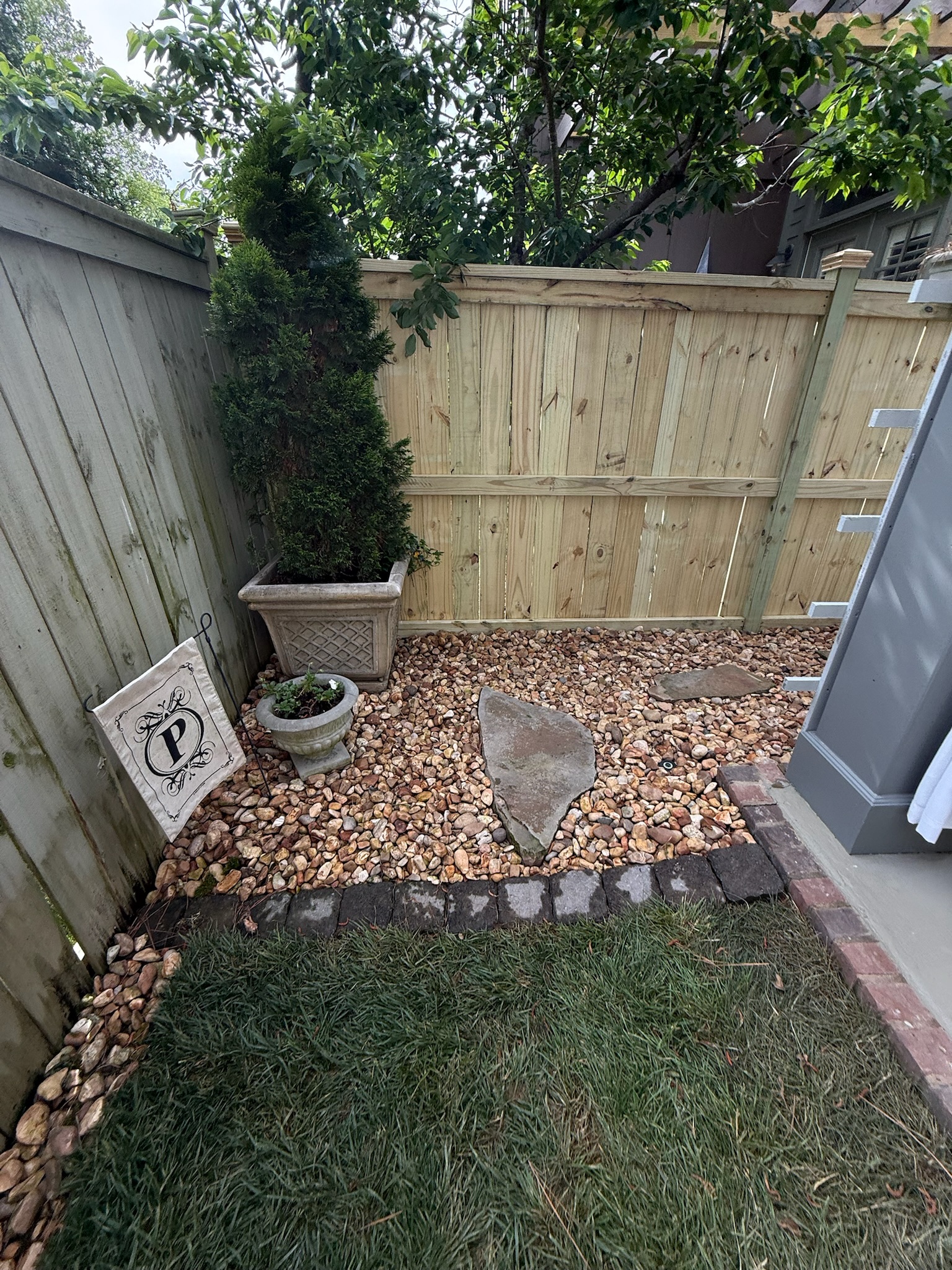
Mix rock sizes and let the path curve. Uniform, single-size rock looks poured and can shift in heavy flow [1].
Mixed sizes
Large boulders at the edges, river rock in the middle and smaller stone at the sides [5].
A winding path
Follow a curving path rather than a straight line [5].
Plants at the edges
Plants along the banks soften the stone and make the bed look like part of the garden [5].
Heavy-duty fabric
Skip thin weed barrier. Use a heavy-duty, water-permeable fabric so the bed keeps draining [1].
Williamson County sits in USDA Plant Hardiness Zone 7b, so pick plants rated for that zone.
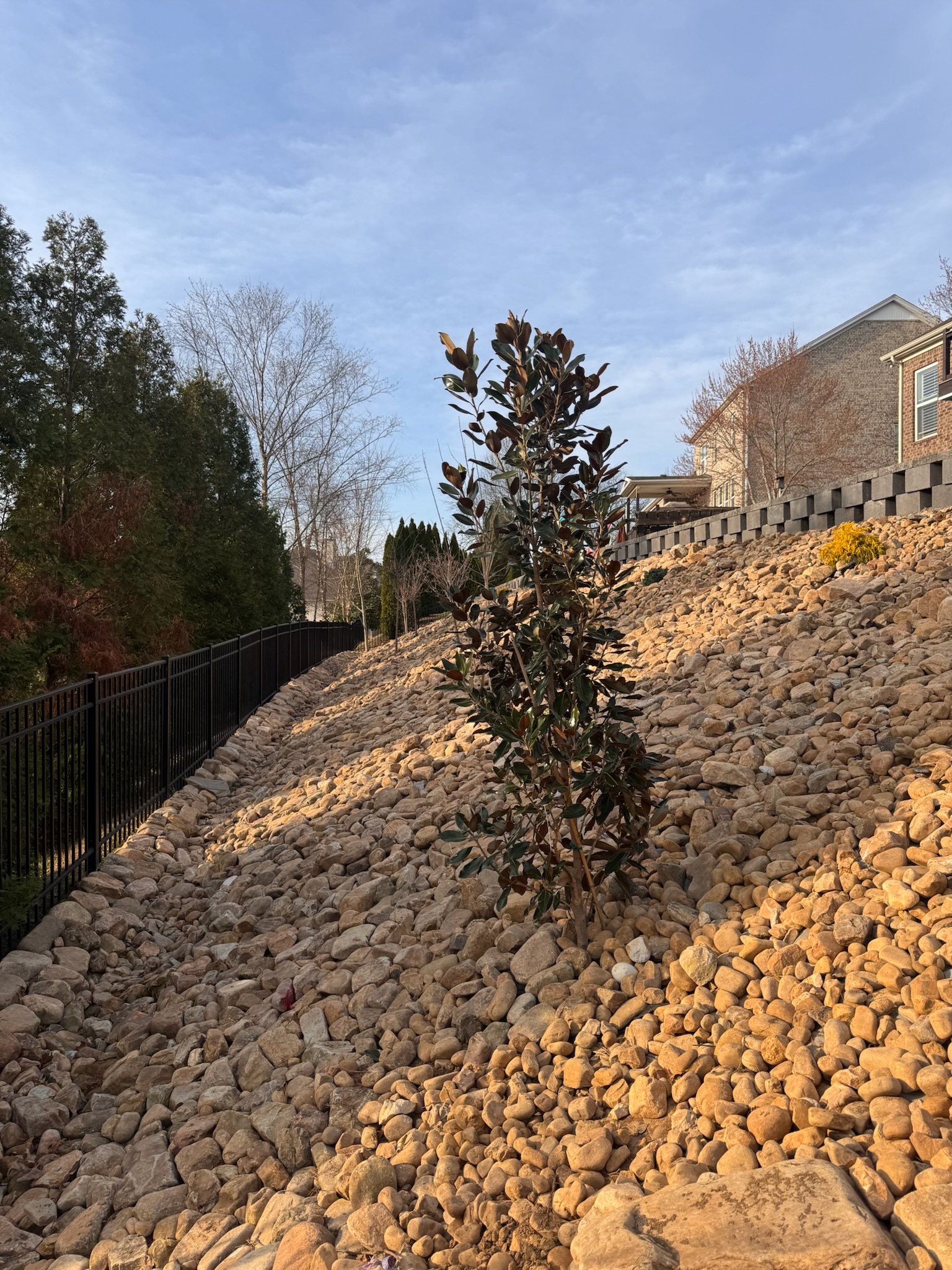
Where does the water go? A checklist before you dig in Franklin or Brentwood
The channel must end at a safe spot on your own lot. A dry creek bed that sends water onto a neighbor’s yard or the street creates a new problem [6].
If water will flow through the bed during the year, check with local authorities before you redirect it to the public stormwater system [5]. For Brentwood, ask the City of Brentwood Planning and Codes Department. For Franklin, ask the City of Franklin Building and Neighborhood Services.
Your pre-dig checklist
- Did I dial 811 and mark irrigation lines?
- Where does the channel end, and is that spot on my lot?
- Does my HOA need to approve a rock feature or a change to the yard?
- Does my city need to approve changes to where water leaves my lot?
- Can the channel keep a 1% fall from top to outlet?
One guide names a dry well as an outlet, and dry wells typically cost $500 to $3,000 [9]. Another names a storm drain or a wooded area [2]. That is why the city and HOA check comes first.
Live in Brentwood or Franklin? Ask for a site visit and we will walk the water path with you.
Get a dry creek bed designed for your yard
Pineda Properties builds drainage and landscape features across Franklin, Brentwood, Spring Hill, Nolensville, Thompson’s Station, College Grove, Fairview and Nashville. Pineda prices each project after a free site visit.
Get my free estimate Call (615) 899-5766Dry creek bed questions from Williamson County homeowners
How much does a dry creek bed cost?
Online guides put a professionally installed dry creek bed at about $20 to $50 per linear foot. A larger bed with boulders and plants runs $1,500 to $5,000 or more. Other guides go higher, so get a quote for your yard.
Does a dry creek bed really work for drainage?
Yes, for water that runs across the surface. A dry creek bed channels storm runoff to an outlet. It does not drain ground that is soggy with nothing flowing on top. That job belongs to a French drain.
How deep should a dry creek bed be?
For one downspout, plan about 6 to 8 inches deep and 18 to 24 inches wide. For heavier runoff, plan 12 to 18 inches deep and 3 to 4 feet wide or more. Keep the channel about twice as wide as it is deep.
What size rock do you use in a dry creek bed?
Mix sizes. One guide uses 3 to 5 inch river rock in the main channel and boulders along the edges. Another suggests edge stones over 10 inches across. Mixed sizes look natural and hold better than one uniform size.
Do you need landscape fabric under a dry creek bed?
Yes. Fabric keeps soil from working up into the rock. Skipping it is one of the main reasons a bed stops draining within a couple of seasons. Use a heavy-duty, water-permeable fabric, not thin weed barrier.
Do I need a permit for a dry creek bed in Franklin or Brentwood?
If the water will flow to the public stormwater system, check with your city first. Ask the City of Brentwood Planning and Codes Department or the City of Franklin Building and Neighborhood Services. Your HOA may also need to approve changes to your yard.
Sources
- Yard Drainage Fixes, “Dry Creek Bed for Drainage: Sizing, Slope, Cost and Mistakes”, last reviewed September 15, 2026
- LawnsGuide, “Designing a Dry Creek Bed for Landscape Drainage”, June 2, 2026
- Georgian Landscape Design (Alpharetta, GA), “Dry Creek Beds Pricing Guide”, 2026
- LatestCost, “Dry Creek Bed Cost Guide for Home Landscaping 2026”
- Clark County Master Gardeners, “Dry Stream Beds” (older handout, dated March 2005), as hosted by the University of Arkansas Cooperative Extension Service
- MSI Surfaces, “How To Build A Dry Creek Bed Using River Rock”, February 13, 2022, updated July 22, 2024
- NOAA National Centers for Environmental Information, U.S. Climate Normals 1991–2020, Nashville International Airport (USW00013897)
- Ecology Action Center, “How Much Water Can a Rain Barrel Collect?”
- LawnStarter, “How Much Does a French Drain Cost in 2026?”, updated October 5, 2026