
Franklin and Williamson County planting guide
Middle Tennessee planting calendar: zone 7b frost dates and what to plant each month
Your ZIP code’s zone, the real frost dates, and a month-by-month plan for trees, shrubs, beds and lawn.
Quick answer
Franklin and all of Williamson County are USDA zone 7b on the 2023 map. At Nashville’s official weather station, the average last spring freeze is March 31 and the average first fall freeze is November 3. For tender plants, April 16 is the low-risk date, with only a 1 in 10 chance of a later freeze. Fall is the best time to plant trees and shrubs.
What planting zone is Franklin, TN?
Franklin is in USDA zone 7b. So is every other town in Williamson County, plus central Nashville. [2]
Zone 7b means the average coldest winter night lands between 5 and 10°F. [2] Plants rated for zone 7 or colder will handle a normal winter here.
| Town | ZIP code | Zone | Average coldest winter night |
|---|---|---|---|
| Franklin | 37064, 37067, 37069 | 7b | 5 to 10°F |
| Brentwood | 37027 | 7b | 5 to 10°F |
| Spring Hill | 37174 | 7b | 5 to 10°F |
| Nolensville | 37135 | 7b | 5 to 10°F |
| Thompson’s Station | 37179 | 7b | 5 to 10°F |
| College Grove | 37046 | 7b | 5 to 10°F |
| Fairview | 37062 | 7b | 5 to 10°F |
| Nashville | 37203, 37211, 37215 | 7b | 5 to 10°F |
Source: USDA 2023 Plant Hardiness Zone Map, ZIP lookups. [2]
Why some plant tags still say 7a
The older 2012 map put most of Middle Tennessee in zone 7a. [2] The 2023 update moved the area into 7b. Brentwood shows the full history: 6b on the 1990 map, 7a in 2012, and 7b in 2023. [3]
That shift does not mean you can grow anything. Your zone tells you which plants survive winter, not when to plant them. For timing, you need frost dates.
When is the last frost in Nashville and Franklin?
The average last spring freeze at Nashville International Airport is March 31. The safer date for tender plants is April 16, when the chance of another 32°F night drops to 1 in 10. [1]
These numbers come from the official NOAA 1991–2020 climate normals for the airport station, the closest long weather record to Franklin. [1]
Why frost dates online disagree
Frost sites often show one date with no label. Behind that single date are two hidden choices: which temperature counts as “frost,” and how much risk you accept. Change either one and the date moves by weeks.
| Threshold | What it means for your plants | Last in spring | First in fall |
|---|---|---|---|
| 36°F light frost | Frost can form on leaves on clear, calm nights. Tender seedlings can get nipped. | Apr 11 | Oct 25 |
| 32°F freeze | Water freezes. Tender annuals, tomatoes and fresh new growth can die. | Mar 31 | Nov 3 |
| 28°F hard freeze | The “killing” freeze. It damages most tender plants and can hurt new growth on hardy ones. | Mar 17 | Nov 15 |
Source: NOAA NCEI U.S. Climate Normals 1991–2020, Nashville International Airport. [1]
The 50% date is only a coin flip. Half of all years still get a freeze after it. The chart below shows how fast that risk falls as spring goes on.
Chance of a 32°F freeze after each date, Nashville International Airport. Source: NOAA NCEI U.S. Climate Normals 1991–2020. [1]
Late freezes do happen. Nashville’s latest spring freeze on record came on April 25, 1910. [4]
Which date should you use?
- Hardy shrubs, trees and perennials: late March is fine, once the March 17 hard-freeze average has passed. [1]
- Tender annuals and vegetables: wait for April 16, the 1-in-10 date. [1]
- Warm-season plants such as tomatoes and peppers: many local gardeners wait until late April or Mother’s Day for warmer soil.
When is the first fall frost in Middle Tennessee?
The average first fall freeze in Nashville is November 3. A light 36°F frost comes earlier, around October 25, and the first 28°F hard freeze averages November 15. [1]
Use these dates to bring in tender pots, finish summer crops and get your sprinkler system winterized.
| Date | Chance the first freeze has come |
|---|---|
| Oct 22 | 10% |
| Oct 26 | 20% |
| Oct 30 | 30% |
| Nov 1 | 40% |
| Nov 3 | 50% (average) |
| Nov 6 | 60% |
| Nov 9 | 70% |
| Nov 13 | 80% |
| Nov 18 | 90% |
Source: NOAA NCEI U.S. Climate Normals 1991–2020, Nashville International Airport. [1]
Between the average last and first freeze, you get a 217-day growing season. [1] The area also averages 50.51 inches of rain and melted snow a year, with 4.7 inches of snowfall. [1] That steady winter and spring rain is a big reason fall planting works so well here.
Your Middle Tennessee planting calendar, month by month
Here is the whole year at a glance for zone 7b. “Best” is the ideal window, “OK” works with a little extra care, and “Wait” means a better window is coming.
The calendar combines UT Extension timing for lawns and shrubs with NOAA frost dates for Nashville. [5] [6] [1]
| Month | Trees & shrubs | Perennials | Spring bulbs | Tall fescue seed | Bermuda / zoysia | Annuals & vegetables | Mulch & beds |
|---|---|---|---|---|---|---|---|
| Jan | OK | Wait | Wait | Wait | OK (dormant sod) | Wait | OK |
| Feb | OK | Wait | Wait | Wait | OK (dormant sod) | Wait | OK |
| Mar | OK | OK | Wait | Wait | Wait | Wait | Best |
| Apr | OK | Best | Wait | Wait | Wait | OK (after Apr 16) | Best |
| May | OK | OK | Wait | Wait | Best | Best | OK |
| Jun | Wait | Wait | Wait | Wait | Best | OK | OK |
| Jul | Wait | Wait | Wait | Wait | Wait | Wait | OK |
| Aug | Wait | Wait | Wait | OK | Wait | Wait | OK |
| Sep | OK | OK | OK | Best | Wait | Wait | OK |
| Oct | Best | Best | Best | OK (by mid-Oct) | Wait | Wait | Best |
| Nov | Best | OK | OK (early Nov) | Wait | Wait | Wait | Best |
| Dec | OK | Wait | Wait | Wait | OK (dormant sod) | Wait | OK |
Built by Pineda Properties from UT Extension turf and shrub guidance and NOAA 1991–2020 frost normals for Nashville. [5] [6] [1]
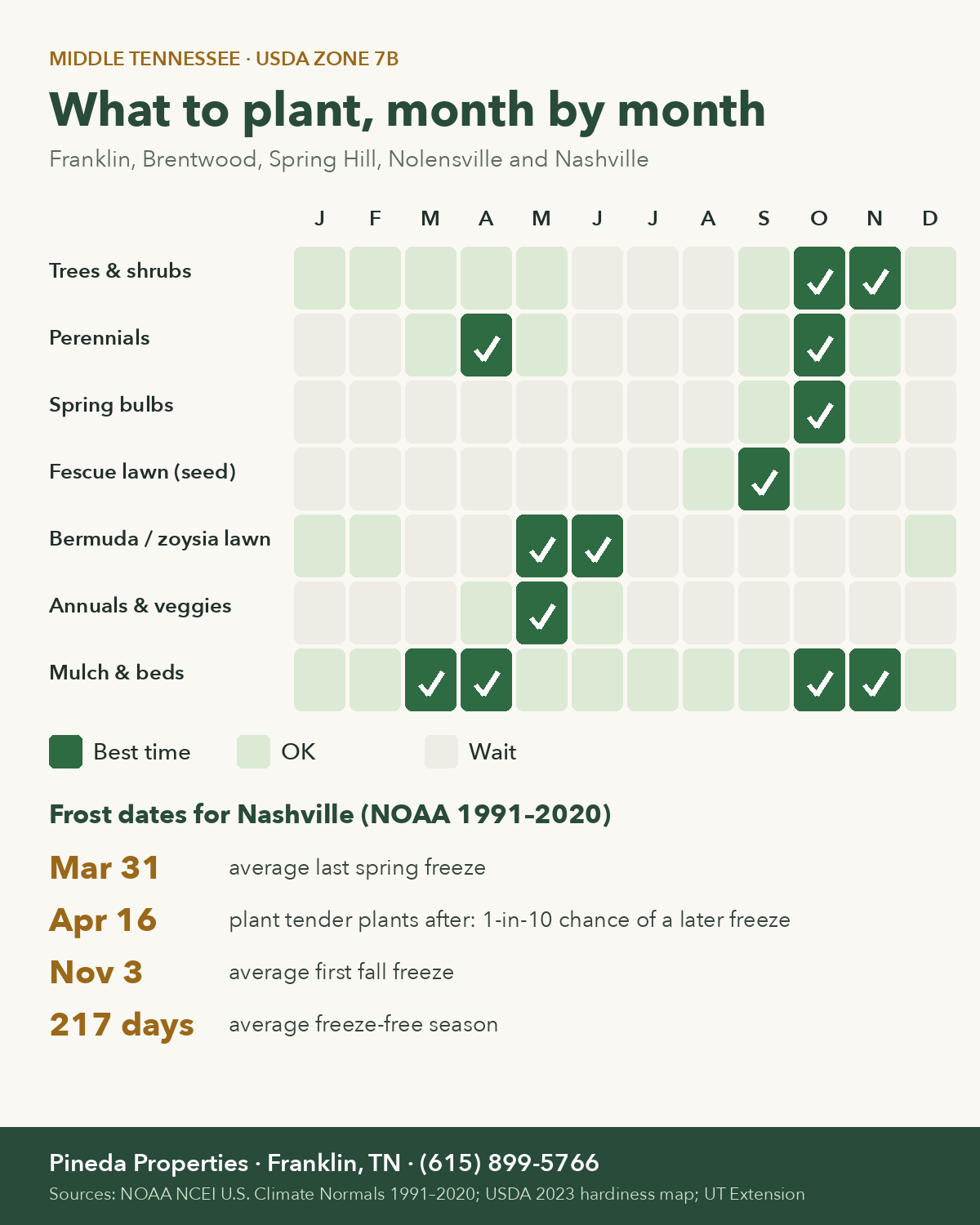
How to read the summer “Wait” for trees and shrubs
Container and balled-and-burlapped plants can go in any time the ground is not frozen. [6] Summer planting works if you keep up with water, but a fall start is far easier on new roots. If you can wait for October, wait.
Fall is the best time to plant trees and shrubs in Tennessee
Fall is the top planting season for trees and shrubs in Tennessee. Cool air eases stress on the leaves, warm soil keeps roots growing, and winter and spring rain help them settle in before summer heat. [6]
In Middle Tennessee, the best day to plant a tree is a cool fall day, not the first warm day of spring.
A shrub planted in October has months to grow roots before its first July. A shrub planted in May gets a few weeks, then faces summer with a small root ball. That is why fall plantings tend to need less babysitting the next year.
Fall is also the right time to build new beds. Your plants, mulch and edging all go in together, and the bed looks settled by spring. See how we handle flower bed installation and landscape design and installation in Franklin.
When to seed or sod your lawn in Middle Tennessee
Seed tall fescue in late summer or early fall. Plant bermuda, zoysia and centipede from May 1 to June 30. [5]
Here is the exact guidance from the University of Tennessee Master Gardener turf chapter. [5]
Tall fescue (cool-season)
Tall fescue “should be planted in late summer or early fall and no later than mid-October.” [5]
Shady lawns
For shade, UT advises cool-season seeding “from mid-August to mid-September.” [5]
Bermuda, zoysia, centipede
“Seed, plugs, or sprigs of bermudagrass, centipedegrass, or zoysiagrass should be planted between May 1 and June 30.” [5]
Winter sod
Bermuda and zoysia sod can be laid while dormant in winter. It roots slowly until the grass wakes up in spring. [5]
It is November, so the fescue window has closed for this year. Mark late August on your calendar for fescue seed. If you need cover sooner, dormant warm-season sod is the winter option. Learn more about sod installation.
What to plant and do in November and December
November and December are prime time for trees, shrubs and bed work. The fescue window is closed, but your yard still has plenty to gain right now.
- Plant trees and shrubs. Fall is the best season for them in Tennessee. [6] Container and balled-and-burlapped plants can go in any day the ground is not frozen.
- Finish spring bulbs early in the month. Tulips and daffodils go in during fall, after the first cool nights. Get them in during early November.
- Build or refresh beds. Shape new beds, add edging and top with mulch after planting. Our step-by-step mulch guide shows how.
- Winterize your sprinkler system. The first 32°F freeze averages November 3 and the first hard freeze averages November 15. [1] Follow our sprinkler winterizing guide.
- Water new plantings in dry spells. New roots keep growing in cool soil, so do not let fresh plantings dry out, even in December.
- Lay dormant sod if you need it. Bermuda and zoysia sod can go down in winter and will root as spring arrives. [5]
- Fix wet spots before spring. Note where water stands after a winter rain. That is where new plants will struggle. Our drainage solutions page explains the options.
Coming up: January to May
- January and February: plant trees and shrubs on mild days when the ground is workable. Dormant sod is still an option.
- March: hardy plants can go in after the March 17 hard-freeze average. The average last freeze is March 31. [1]
- April: plant tender annuals and vegetables after April 16. [1]
- May: plant warm-season plants and start bermuda or zoysia from seed, plugs or sprigs. [5]
How to plant in Middle Tennessee clay soil
Middle Tennessee soils are often heavy clay. Plant into clay by digging wide, setting plants at or a little above grade, and making sure water can drain away.
The challenge with clay is water: it drains slowly, and roots can sit wet after a rain. These steps help.
- Wait until the soil crumbles. Squeeze a handful. If it forms a sticky ribbon, it is too wet to dig. Working wet clay packs it hard.
- Dig wide, not deep. Make the hole much wider than the root ball, so roots can spread into loosened soil. Keep the bottom firm so the plant does not sink.
- Plant a little high. Set the top of the root ball at or slightly above the ground around it. In clay, a plant set too deep can drown.
- Test the hole first. Fill it with water before you plant. If water still stands the next day, pick another spot, build a raised bed, or fix the drainage.
- Mulch, but keep it off the trunk. A layer of mulch keeps clay from crusting and holds steady moisture. Pull it back from stems and trunks.
Get your yard planted at the right time this fall
Pineda Properties designs and installs planting beds, trees, shrubs, sod, irrigation and drainage across Franklin, Brentwood, Spring Hill, Nolensville and the rest of Williamson County. Rated 4.8 on Google by 67 homeowners.
Get a free estimate Call (615) 899-5766Planting questions from Williamson County homeowners
What planting zone am I in in Middle Tennessee?
Most of Middle Tennessee, including Nashville, Franklin and every Williamson County ZIP code, is USDA zone 7b on the 2023 map. Zone 7b means the average coldest winter night is 5 to 10°F. The older 2012 map had most of the area in zone 7a, which is why some plant tags still say 7a.
Is Nashville zone 7a or 7b?
Nashville is zone 7b on the current 2023 USDA map. It was mostly 7a on the 2012 map. Brentwood, for example, moved from 6b in 1990 to 7a in 2012 and 7b in 2023.
What’s the difference between growing zone 6a and 6b?
Each USDA zone is split into an “a” and a “b” half, each covering a 5-degree band of average coldest winter nights. The “b” half is the warmer one. Williamson County is 7b, which means 5 to 10°F, so plants rated for zones 6a and 6b are hardy here too.
When is the last frost date in Nashville?
The average last 32°F freeze at Nashville International Airport is March 31, based on NOAA 1991–2020 normals. That is only a 50% date. For tender plants, April 16 is the safer choice, with a 1 in 10 chance of a later freeze.
What temperature is considered a killing frost?
A hard or “killing” freeze is usually measured at 28°F, which damages most tender plants. At 32°F, water freezes and tender annuals and vegetables can die. A light frost can form on leaves when the official reading is 36°F on a clear, calm night.
What can I plant in Tennessee right now, in November?
November is one of the best months to plant trees and shrubs in Middle Tennessee, and you can still get spring bulbs like tulips and daffodils in early in the month. Dormant bermuda or zoysia sod can also go down in winter. Tall fescue seed should wait until late summer, since UT advises planting it no later than mid-October.
How do you know when the last spring frost is?
No one knows the exact date ahead of time, so use probability. In Nashville, the chance of a 32°F freeze after March 31 is 50%, after April 9 it is 20%, and after April 16 it is 10%. Watch the 10-day forecast in April and cover tender plants if a cold night appears.
Sources
- NOAA National Centers for Environmental Information, U.S. Climate Normals 1991–2020, Nashville International Airport (station USW00013897)
- USDA Agricultural Research Service, 2023 Plant Hardiness Zone Map (ZIP lookups checked November 7, 2026)
- National Gardening Association, USDA hardiness zone finder by ZIP code (Brentwood, TN: 1990, 2012 and 2023 maps)
- WSMV 4 Nashville, report on spring planting and freeze records, March 25, 2026
- UT Extension, Tennessee Extension Master Gardener, Chapter 10: Turfgrass Management in Tennessee
- UT Extension, Master Gardener Day shrub information (fall planting guidance, PDF)