
French drains manage water within saturated soil, while surface drains collect visible runoff and standing water. Learn how the two systems differ and when your yard may need both.
A French drain is generally best for water moving through or collecting within saturated soil, while a surface drain is better for quickly collecting water that pools or flows across the ground. If your yard has both soggy soil and visible standing water after rain, the right solution may combine the two systems.
Choosing between a French drain and a surface drain depends on where the water comes from, how it moves through the property, the soil conditions, and where the collected water can be discharged safely. A professional drainage assessment can help identify the source of the problem before trenches, pipes, or catch basins are installed.
Here is a quick comparison:
| Feature | French Drain | Surface Drain |
|---|---|---|
| Primary Purpose | Collects and redirects water within saturated soil | Collects visible runoff and standing water |
| How Water Enters | Water filters through gravel and enters a perforated pipe | Water enters through a grate, catch basin, or drainage channel |
| Best Yard Conditions | Soggy lawns, wet slopes, saturated planting beds, and subsurface water movement | Low spots, patios, driveways, walkways, and areas receiving concentrated runoff |
| Typical Pipe | Perforated drainage pipe | Solid drainage pipe connected to a surface inlet |
| Visibility | Usually concealed beneath gravel, soil, or landscaping | The drain grate, catch basin, or channel remains visible |
| Water Collection Speed | Collects subsurface moisture gradually | Captures concentrated surface water quickly |
| Best Fit | Persistent underground moisture and saturated soil | Water pooling or flowing on top of the ground |
A French drain is a subsurface drainage system that intercepts water as it moves through the soil.
The system typically consists of:
Water filters through the soil and gravel before entering the perforated pipe. The pipe then carries the water toward an approved outlet, such as a drainage area, daylight outlet, dry well, or another site-specific discharge solution.
The gravel creates a path through which water can move more easily. Geotextile fabric helps separate the surrounding soil from the drainage aggregate, reducing the amount of sediment entering the system.
A French drain may be appropriate when:
French drains are often useful on sloped properties because they can intercept water moving downhill below the surface.
However, a French drain is not automatically the best choice for every wet yard. Soil with slow infiltration, an undersized pipe, insufficient slope, or a poor outlet can prevent the system from working as intended.
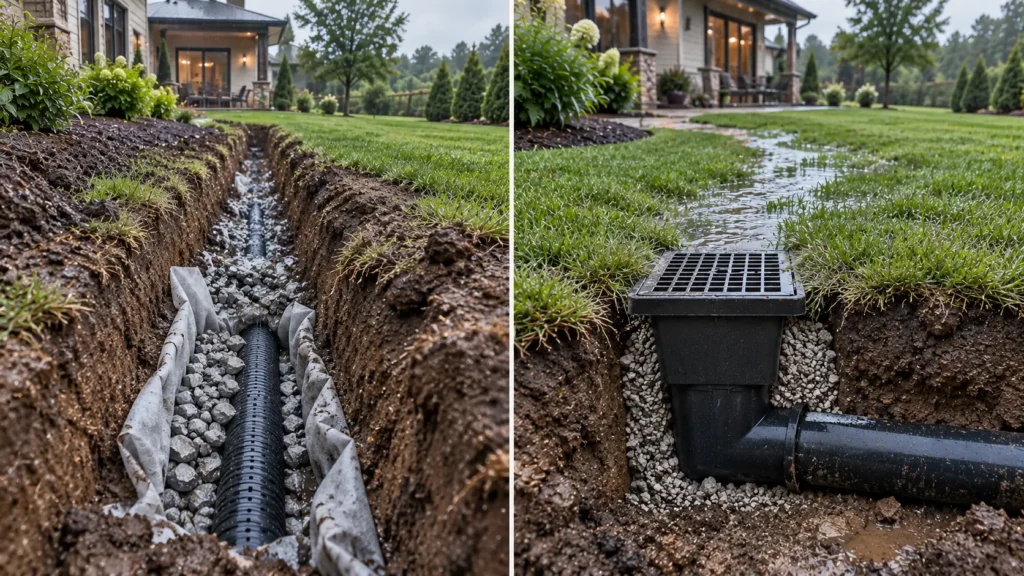
A surface drainage system collects water through an opening installed at or slightly below ground level.
Common surface drainage components include:
Water flows toward the inlet based on the surrounding grade. Once it enters the catch basin or channel, a solid pipe carries it away from the problem area.
Surface drains are designed to move concentrated water relatively quickly. This makes them useful during heavy rain when water collects faster than the soil can absorb it.
A surface drain may be the better option when:
The drain inlet must be placed where water naturally travels or collects. Installing a catch basin away from the true low point can leave much of the original problem unresolved.
Neither system is universally better. The correct choice depends on the type and source of the water problem.
A French drain is usually the stronger choice when the ground remains saturated even after standing water has disappeared. It can intercept moisture moving through the soil and reduce persistent sogginess.
Think of a French drain as a system for water in the ground.
A surface drain is usually more suitable when you can see water flowing or collecting during a storm. It provides a direct entry point for runoff and can move a large concentration of water away from a specific area.
Think of a surface drain as a system for water on the ground.
The timing of the problem can provide another clue.
Water that rushes across the property or forms a puddle during heavy rain often points to a surface runoff issue. Ground that remains wet for several days may indicate slow-draining soil, subsurface water movement, or a combination of drainage problems.
A yard may need both a French drain and a surface drain when it experiences multiple types of water movement.
For example, runoff from a roof or driveway may flow into a low part of the lawn, while the soil in that same area remains saturated between storms. A surface inlet can capture the concentrated runoff, while a French drain can address moisture moving through the surrounding soil.
A combined system may be appropriate when:
The components should be designed as one coordinated drainage plan. Connecting pipes without calculating the water volume, pipe capacity, grade, and outlet conditions can overload the system.
A successful drainage installation involves more than placing a pipe underground. Several site conditions affect how well the system will perform.
Before installing anything, determine whether the water is coming from:
Correcting the source may reduce the amount of water the new system needs to manage. The University of Minnesota Extension recommends evaluating grading, gutters, and downspouts before moving to more involved subsurface drainage work.
Collected water must have somewhere appropriate to go. A drainage system should not simply move water from one problem area to another.
The outlet must comply with applicable property, drainage, utility, and municipal requirements. Water should not be directed toward a neighboring property, septic area, building foundation, or location where it could cause erosion.
Drainage pipe needs a planned route and sufficient fall to move water toward the outlet. The exact slope and pipe size should be based on the site, drainage area, expected water volume, soil, pipe material, and outlet elevation.
If the property does not provide a workable gravity-fed outlet, another approach may be necessary.
French drains typically use perforated pipe because water must enter along the length of the trench.
Surface drains typically connect to solid pipe so the captured water remains inside the line until it reaches the outlet. Using perforated pipe after a catch basin could release water back into soil that is already wet.
French drains need appropriate aggregate and filtration to reduce soil migration into the trench. Surface drain grates and catch basins require access for removing leaves, mulch, soil, and other debris.
Geotextile fabric can help filter sediment in a French drain, but the material and installation method must still allow water to enter. The University of Minnesota Extension notes that permeable fabric and gravel surrounding a perforated pipe help filter sediment and reduce blockage.
Utility lines should be located before excavation begins. Drainage routes may need to change based on the location of electrical, gas, water, communication, irrigation, or septic components.
The installation plan should account for:
A drainage system should support the broader landscape design rather than interfere with how the yard is used.
Sometimes. If the problem is caused by a small depression or soil sloping toward the house, correcting the grade may allow water to move away naturally.
Grading may be enough when:
Other properties require drainage pipe because there is not enough room to create a reliable surface route. In many cases, grading and drainage work together.
Consider having the property assessed when:
Drainage problems are often connected. Treating one visible puddle without examining the surrounding slopes, roof runoff, soil, and discharge route may only relocate the water.
| Feature | French Drain | Surface Drain |
|---|---|---|
| Primary Purpose | Collects and redirects water within saturated soil | Collects visible runoff and standing water |
| How Water Enters | Water filters through gravel and enters a perforated pipe | Water enters through a grate, catch basin, or drainage channel |
| Best Yard Conditions | Soggy lawns, wet slopes, saturated planting beds, and subsurface water movement | Low spots, patios, driveways, walkways, and areas receiving concentrated runoff |
| Typical Pipe | Perforated drainage pipe | Solid drainage pipe connected to a surface inlet |
| Visibility | Usually concealed beneath gravel, soil, or landscaping | The drain grate, catch basin, or channel remains visible |
| Water Collection Speed | Collects subsurface moisture gradually | Captures concentrated surface water quickly |
| Best Fit | Persistent underground moisture and saturated soil | Water pooling or flowing on top of the ground |
Pineda Properties provides drainage and erosion solutions for homeowners in Franklin and surrounding Williamson County communities. Our team evaluates how water enters, moves through, and exits the property before recommending a French drain, surface drain, grading improvements, or a combined system.
A site-specific plan can help protect lawns, landscaping, patios, retaining walls, and outdoor living areas while making the yard more functional after heavy rain.
A French drain is better for collecting water within saturated soil, while a surface drain is better for visible runoff and standing water. The right choice depends on whether the problem is primarily above or below the ground.
A French drain can help when standing water is connected to saturated soil, but it does not collect concentrated surface runoff as quickly as a properly positioned catch basin. A surface inlet may be needed when water forms rapidly during rain.
A surface drain can remove water that pools above the lawn, but it may not fully correct moisture held within the soil. Persistent saturation may require a French drain, soil improvements, grading, or a combined drainage plan.
They may be incorporated into one drainage plan, but the layout, pipe selection, water volume, slope, and discharge point must be evaluated carefully. Surface water and subsurface water may need separate piping in some installations.
Grading may solve the problem if water can be redirected safely across the surface. A French drain may be necessary when water moves through the soil or the property does not have a practical surface drainage route. Some yards need both.
Possible causes include incorrect drain placement, insufficient pipe capacity, poor slope, clogged materials, compacted soil, a blocked outlet, or an unaddressed water source. A drainage assessment can determine why the system is not performing properly.