
Hardscaping guide · Brentwood, Franklin and Williamson County, TN
Retaining Wall Cost in Franklin and Brentwood, TN: 2026 Price Guide
What a retaining wall costs per square foot, by size and by material, plus the height, engineer and drainage questions that change your price.
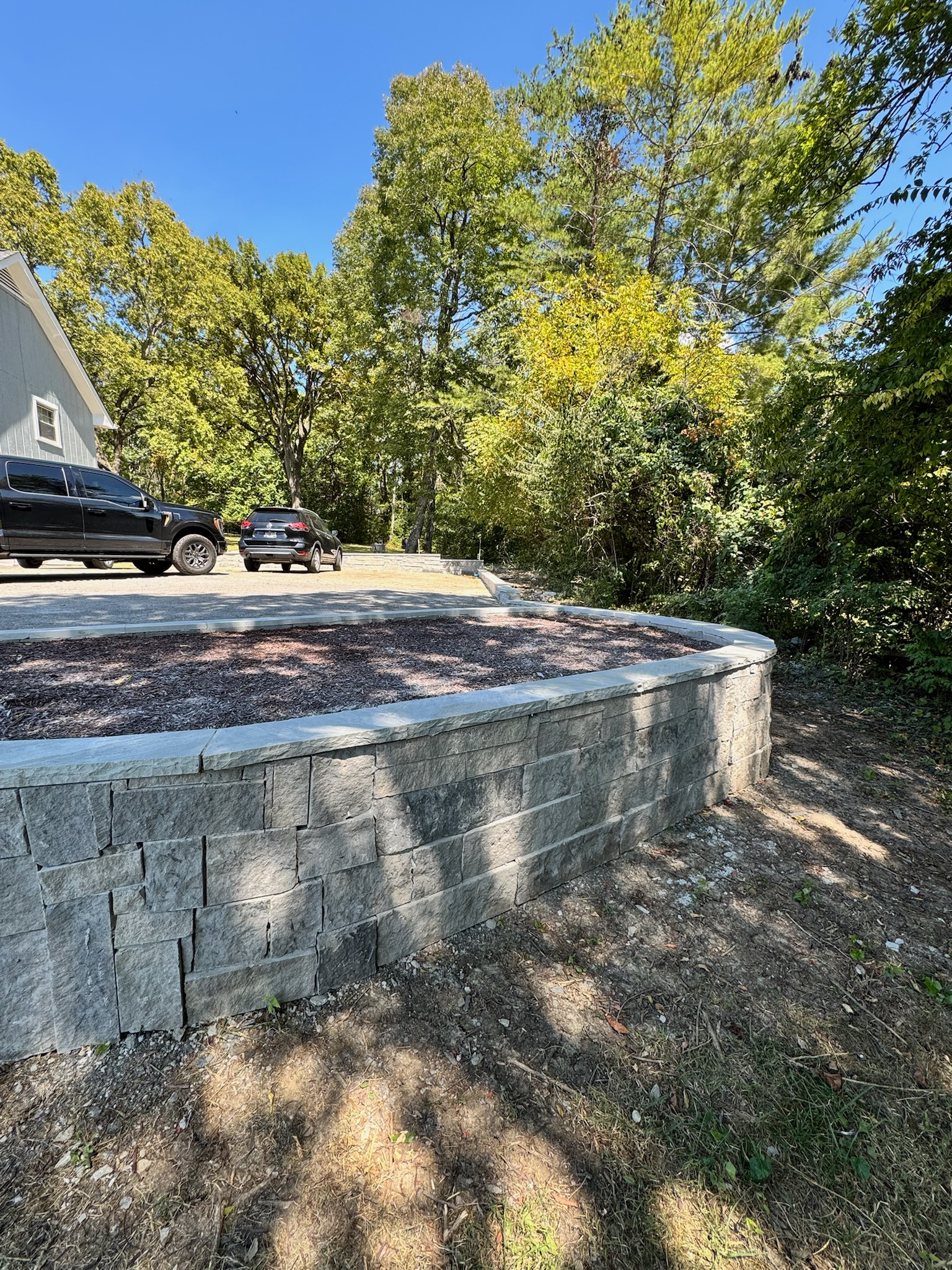
Quick answer
Most retaining walls cost $20 to $53 per square foot of wall face, installed, and the national average is $33 [1]. That puts a typical wall at $3,500 to $9,400 [1]. Height, material, slope and drainage decide where your Brentwood or Franklin wall lands in that range. Pineda prices each wall after a free site visit.
How much does a retaining wall cost?
The national average to install a retaining wall is about $6,300, and most people pay $3,500 to $9,400 [1]. A second national guide puts the average at $6,000 and the usual range at $3,565 to $9,645 [2].
Those totals mix small garden walls with big ones. The better number to compare is the price per square foot of wall face, which is length times height on the side you see. A wall on a Brentwood or Franklin hillside often prices above the middle of the range.
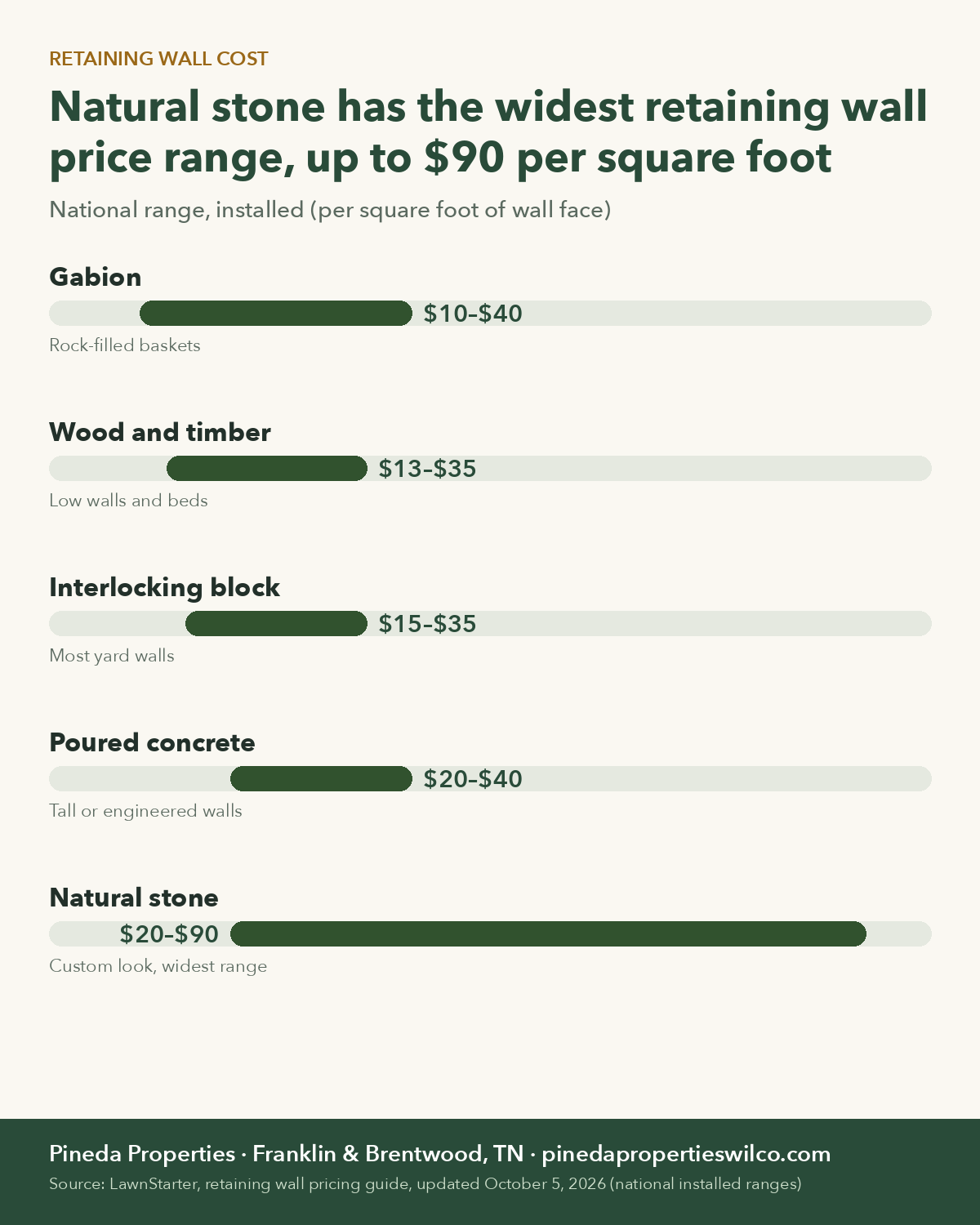
Source: LawnStarter national retaining wall pricing guide, updated October 5, 2026 [1]. Bar length shows the top of each range. National prices, installed, per square foot of wall face.
Retaining wall cost per square foot, by material
Timber is the lowest-cost material and natural stone is the highest. Interlocking block and poured concrete sit in the middle [1].
| Material | Cost per sq ft (national) | Good fit for |
|---|---|---|
| Interlocking block | $15–$35 [1] | Most yard walls. Many colors, flexible curves, fast to build. |
| Poured concrete | $20–$40 [1] | Tall or heavily loaded walls. Usually engineered. |
| Natural stone | $20–$90 [1] | A one-of-a-kind look at the front of the house. |
| Wood and timber | $13–$35 [1] | Low walls and stepped garden beds. |
| Gabion | $10–$40 [1] | Rustic look with built-in drainage through the rock. |
One local estimate for Franklin, TN, from December 2022, puts interlocking block at $19 to $36 and poured concrete at $27 to $39 per square foot [5]. It is older and comes from a lead-generation site. Use it only as a rough check.
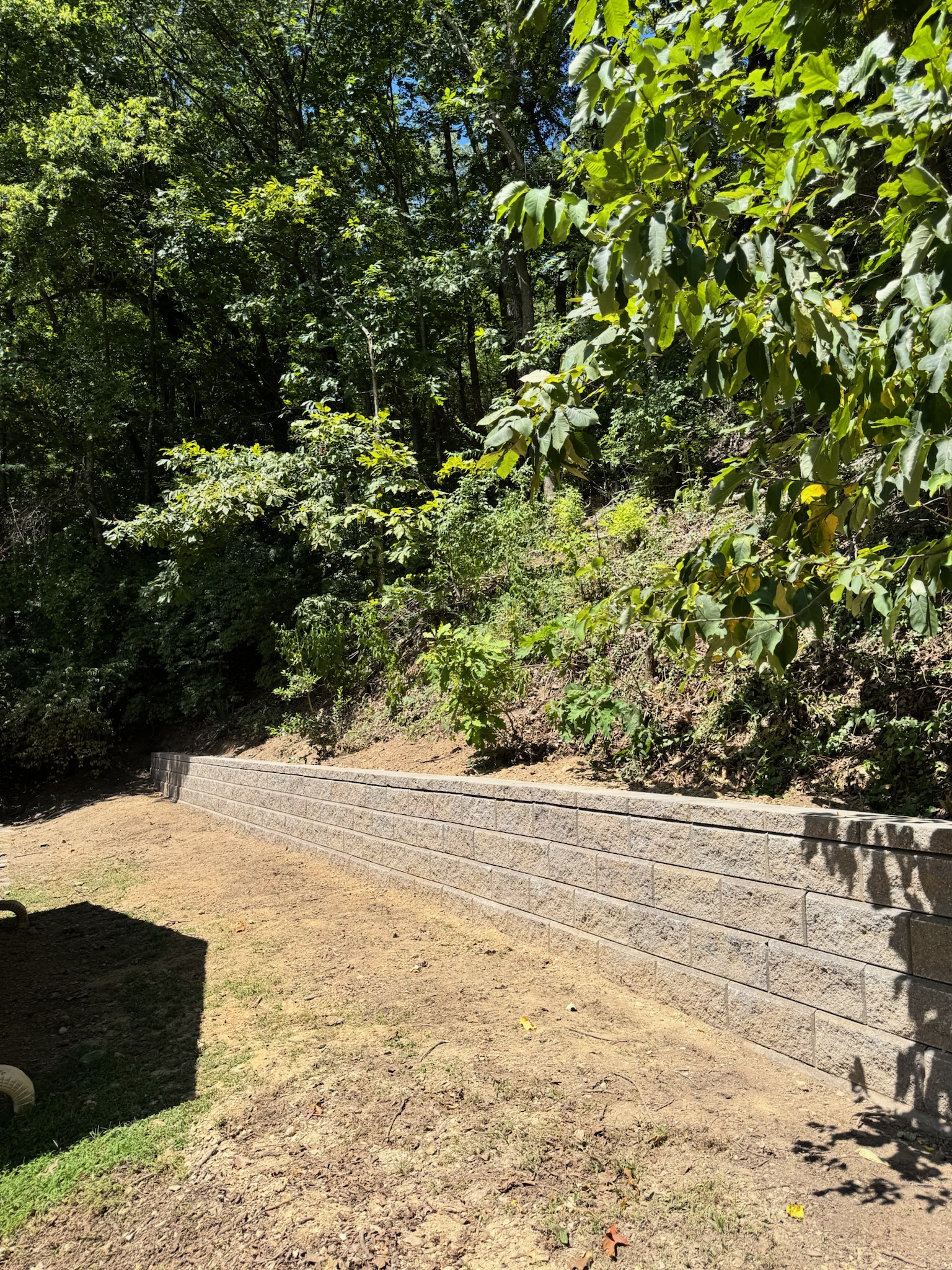
Retaining wall cost by size: what 40, 90, 200 and 360 square feet cost
A low 2-foot garden wall that is 20 feet long costs about $800 to $2,100 at national prices. A 6-foot wall that is 60 feet long can reach about $19,100.
We worked out the table by multiplying wall face area by the national $20 to $53 per square foot range [1]. It covers the wall only. Drainage, grading, steps and permits are extra.
| Wall (height × length) | Face area | Price range | Typical use |
|---|---|---|---|
| 2 × 20 ft | 40 sq ft | $800–$2,100 | Planting bed, front-yard border |
| 3 × 30 ft | 90 sq ft | $1,800–$4,750 | Level a back corner or a patio edge |
| 4 × 50 ft | 200 sq ft | $4,000–$10,600 | Hold a slope behind a house |
| 6 × 60 ft | 360 sq ft | $7,200–$19,100 | Terrace a steep yard (engineered) |
National ranges: face area × LawnStarter installed cost per square foot [1]. Not a Pineda price. Pineda prices each project after a free site visit.
What a retaining wall costs on a slope
A wall on a slope costs about $40 to $200 per linear foot nationally [1]. Slope work often needs regrading and extra prep before the first block goes down [3].
Grading
Land grading runs about $0.40 to $2 per square foot, based on a 2022 national guide [4].
Waterproofing
Waterproofing a wall can add $2 to $10 per square foot [1].
Permits
National guides list permits at $40 to $450, depending on the place [1]. Ask the city for your exact fee.
Labor
Labor runs $10 to $50 per square foot, or $50 to $75 per hour [4].
Height
Taller walls need a wider base, more block and, past a point, an engineer.
A retaining wall holds back soil. The part that decides how long it lasts is how it handles water.
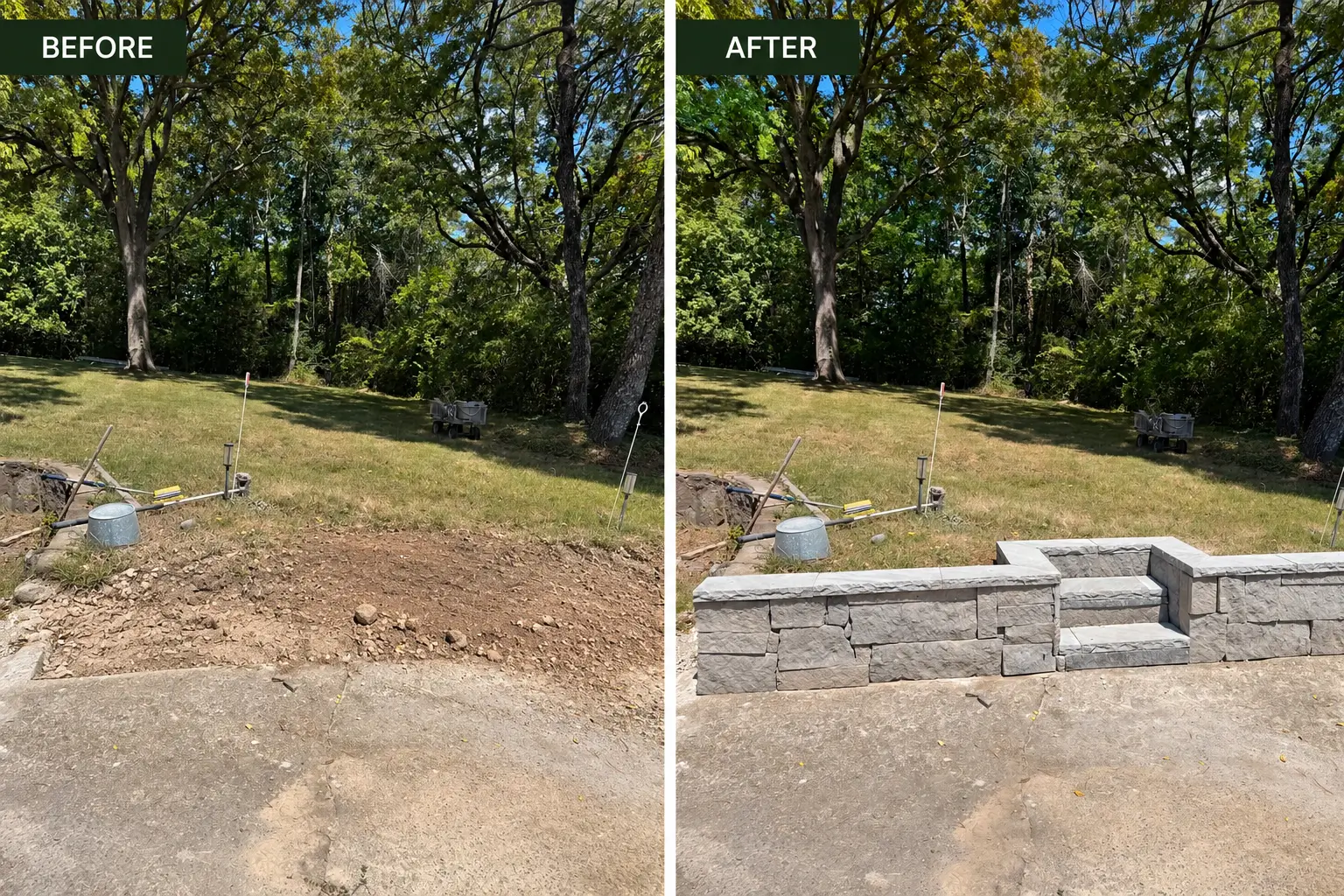
When does a retaining wall need an engineer?
The model building code calls for engineered design when a wall retains more than 48 inches of unbalanced fill, or when a wall over 24 inches also carries extra loads beyond soil [6]. Cost guides use lower or higher lines, so ask your city for the rule that applies to you.
Here is what each source says:
| Source | What it says |
|---|---|
| International Residential Code, section R404.4 (2018 edition) | Engineered design over 48 inches of unbalanced fill, or over 24 inches when the wall also resists loads beyond soil [6] |
| LawnStarter | Walls taller than 3 feet need a structural engineer [1] |
| Lawn Love | Permits are needed over 4 feet and in some areas over 3 feet [2] |
| City of Franklin zoning ordinance | Residential walls cannot pass 2 feet in a front yard or 6 feet in a side or rear yard [7] |
The Franklin limit is measured from the lowest finished grade to the top of the wall [7]. It applies to residential uses other than multifamily.
For Brentwood, ask the City of Brentwood Planning and Codes Department which height triggers a stamped design and an inspection on your lot.
Drainage behind the wall on Middle Tennessee clay
Good drainage is what keeps a wall straight. Water that sits behind a wall pushes on it, and Middle Tennessee soils are often heavy clay that drains slowly. Nashville averages 50.51 inches of rain a year [9].
That is why drainage belongs in the first conversation about price. Adding drainage to an existing wall costs about $60 to $70 per linear foot if the crew can dig behind it [3].
- Dig out behind the wall. The crew leaves room for clean gravel and a drain pipe, at least 12 inches behind the wall [8].
- Line it with fabric. Non-woven geotextile fabric keeps soil out of the gravel so it can keep draining [8].
- Lay the drain pipe low. A perforated pipe sits at the base of the wall and slopes to an outlet [8].
- Backfill with clean gravel. Crushed gravel about ¾ inch in size goes in 4-inch layers, and each layer is compacted [8].
- Send the water somewhere safe. The outlet should run to daylight or a drain, never toward the house.
Soil is not a good backfill, because it holds moisture and can build up water pressure [8]. If your yard also stays wet after rain, read our guide to French drain installation cost, and see our drainage solutions in Franklin.
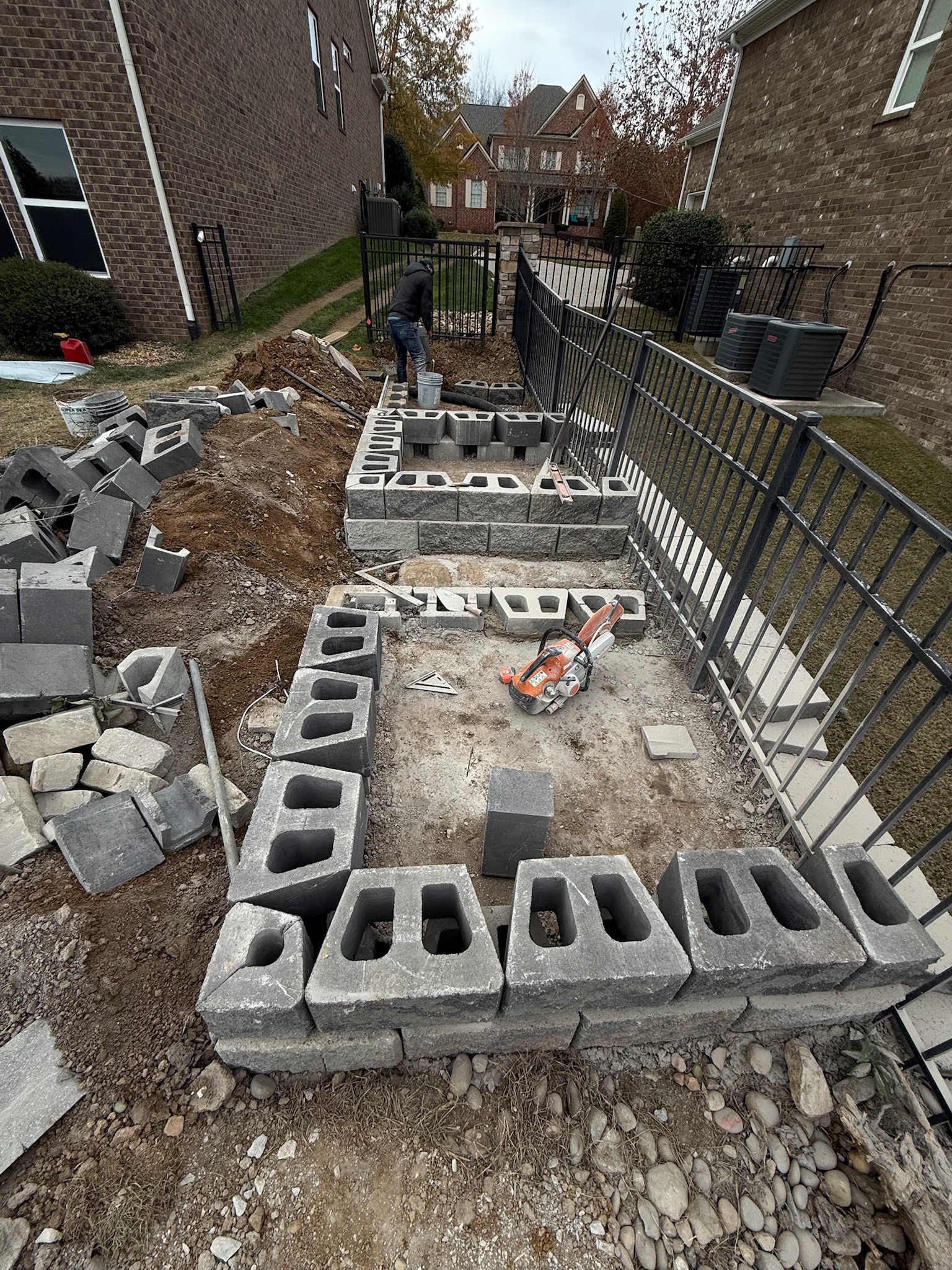
Which retaining wall material fits your yard?
Pick the material for the job first and the look second. Block fits most yards, stone fits the front of the house, and timber fits low beds.
Interlocking block
The workhorse for backyard slopes. Pins and layers lock the wall together, and curves are easy.
Natural stone
Costs more and looks custom. A good match for older Brentwood and Franklin homes with brick or stone fronts.
Poured concrete
Strong for tall or heavily loaded walls. It is usually engineered and can be faced with stone.
Timber
Lowest price per square foot. It suits low walls and stepped garden beds, but a guide notes railroad ties do not go beyond four feet [2].
Want the wall to do more than hold soil? Many walls double as seating or planters. See our retaining wall installation in Franklin page for the styles we build.
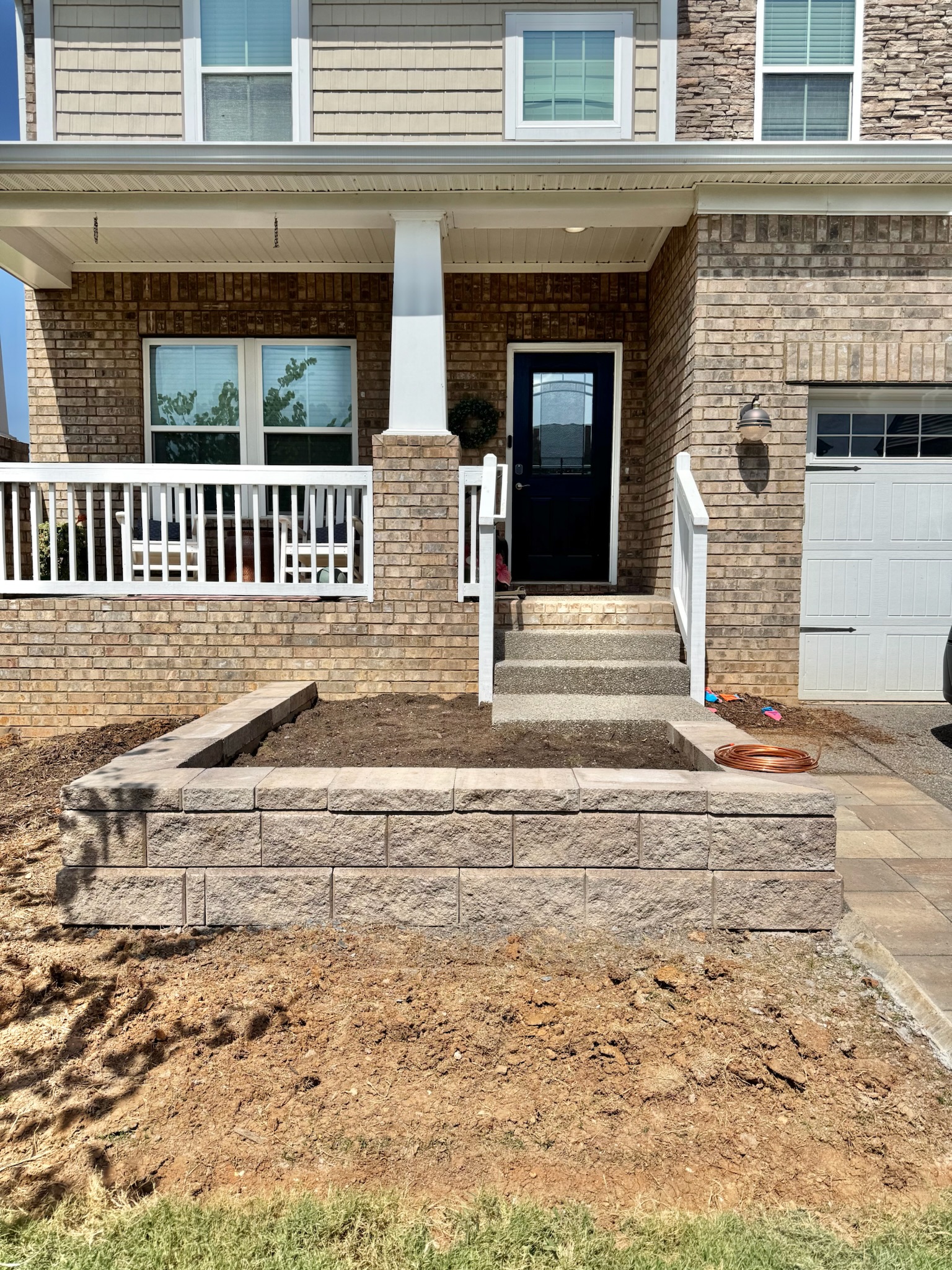
Franklin and Brentwood retaining wall checklist
Before you sign, get five answers: the height, the city rule, the HOA rule, the drainage plan and the underground lines. This checklist keeps them in one place.
| Question | Who answers it |
|---|---|
| How tall is the wall at its tallest point? | Your contractor, on the quote |
| Is the wall within the Franklin height limit (2 ft front yard, 6 ft side or rear yard)? | City of Franklin Building and Neighborhood Services. The limit is in the zoning ordinance [7] |
| Does a Brentwood wall need a permit, a stamped design or an inspection? | City of Brentwood Planning and Codes Department |
| Does the wall need an engineer? | The city, and your contractor. The model code starts at 48 inches [6] |
| Does my HOA need to approve the wall and the color? | Your HOA. This is separate from any city permit. |
| Where will the water go? | Your contractor, in writing, with the drain outlet shown |
| Where are the buried lines? | Tennessee 811. Dial 811 before anyone digs. |
Live in Brentwood or Franklin? Our Brentwood and Franklin pages show the neighborhoods we serve.
How to get an accurate retaining wall quote
An accurate quote starts with a visit to your slope. A phone price cannot see your soil, your access or where the water runs.
- Mark the wall line. Use paint or stakes. Note the tallest point and the total length.
- Say what the wall must do. Hold a slope, make a flat patio, or frame a bed.
- Ask for the engineering answer. The quote should say whether a stamped design is needed and who pays for it.
- Ask where the water goes. Get the drain pipe, gravel and outlet on the quote.
- Get an itemized quote. Look for base, block or stone, backfill, drainage, caps, steps and haul-off.
- Check HOA and city rules. Start approvals before the work date.
- Compare line by line. Match height, base and drainage before you compare totals.
Get a retaining wall quote built for your slope
Pineda Properties designs and builds retaining walls across Franklin, Brentwood, Spring Hill, Nolensville, Thompson’s Station, College Grove, Fairview and Nashville. Pineda prices each project after a free site visit.
Get my free wall estimate Call (615) 899-5766Retaining wall cost questions from Brentwood and Franklin homeowners
How much does a retaining wall cost per square foot?
Most retaining walls cost $20 to $53 per square foot of wall face, installed, and the national average is $33. Block runs about $15 to $35, poured concrete $20 to $40 and natural stone $20 to $90. Pineda prices each wall after a free site visit.
How much does a 4-foot retaining wall cost?
A 4-foot wall that is 25 feet long has 100 square feet of face. At the national $20 to $53 per square foot, that is about $2,000 to $5,300 for the wall alone. Drainage, grading and engineering can add to it.
How much does it cost to build a 50-foot retaining wall?
A 50-foot wall that is 4 feet tall has 200 square feet of face. At national prices that is about $4,000 to $10,600. Slope walls run about $40 to $200 per linear foot, so a 50-foot wall on a slope can cost $2,000 to $10,000.
Do I need a permit for a retaining wall in Franklin, TN?
Franklin’s zoning ordinance limits residential retaining walls to 2 feet in a front yard and 6 feet in a side or rear yard. For permit and inspection questions, ask City of Franklin Building and Neighborhood Services before you build. Your HOA may also need to approve the design.
Do I need an engineer for a retaining wall?
The model residential building code calls for engineered design over 48 inches of unbalanced fill, or over 24 inches when the wall also resists loads beyond soil. Some cost guides draw the line at 3 or 4 feet. Ask your city which rule applies to your lot.
What is the cheapest type of retaining wall?
Timber is usually the lowest-cost material at about $13 to $35 per square foot, and gabion starts near $10. Cheap walls still need a solid base and drainage. A low price that skips drainage can cost more to fix later.
Does a retaining wall need drainage?
Yes. Water behind a wall pushes on it, and Middle Tennessee clay drains slowly. A wall needs clean gravel backfill, fabric and a perforated drain pipe that leads water out. Adding drainage later costs about $60 to $70 per linear foot.
Sources
- LawnStarter, “How Much Does a Retaining Wall Cost in 2026?”, updated October 5, 2026
- Lawn Love, “Retaining Wall Cost”, updated October 9, 2026
- Fixr, “Retaining Wall Cost”, updated January 31, 2025
- Bob Vila, “Retaining Wall Cost”, updated July 6, 2022
- HomeBlue, “Retaining Wall Cost in Franklin, Tennessee”, December 2022
- International Residential Code 2018, Tennessee, Chapter 4, section R404.4 Retaining walls (UpCodes)
- City of Franklin, Tennessee, Zoning Ordinance, retaining wall height limits, effective January 13, 2026
- Western Interlock, “How to Plan for Proper Drainage in Your Retaining Wall Installation”
- NOAA NCEI U.S. Climate Normals 1991–2020, Nashville International Airport