
Drainage cost guide · Franklin & Williamson County
French Drain Installation Cost in Franklin, TN: Your 2026 Price Guide
National price ranges, a cost table for every yard size, and what clay, slope and the outlet add in Middle Tennessee.
Quick answer
A French drain costs about $10 to $65 per linear foot installed, based on national 2025 and 2026 price guides.[1][2] A 100-foot drain runs about $1,000 to $6,500, and the national average project is about $5,000.[1] In Franklin and Williamson County, clay soil, slope, the outlet and lawn repair decide where your yard lands. Pineda prices each drain after a site visit.
How much does a French drain cost per foot?
A French drain costs about $10 to $65 per linear foot installed. Two national price guides, LawnStarter and Glanz Buffat, give that same range.[1][2] An Illinois landscaper, Ware Landscaping, quotes a tighter $20 to $50 per foot.[3]
The price per foot pays for digging the trench, the rock, the pipe and fabric, and the labor to put your yard back. Short, shallow runs in easy ground sit near the low end. Deep trenches, hard digging and long runs to the outlet sit near the high end.
Bar length shows the top of each range. Source: LawnStarter [1], Glanz Buffat [2], Ware Landscaping [3]. National and out-of-state prices, not Franklin quotes.
For the whole project, LawnStarter puts the national average near $5,000.[1] Glanz Buffat, a Louisville company, lists $2,800 to $6,500 for a typical French drain.[2]
Treat these as a starting range. Your own price depends on your soil, your slope and where the water can go.
French drain cost by project size
A short downspout line can cost a few hundred dollars. A whole-backyard system can pass $15,000. The table multiplies common drain lengths by the national range of $10 to $65 per foot.[1][2]
| Project | Typical length | Rough cost at $10–$65 / ft | Good fit when |
|---|---|---|---|
| Short downspout line | 20–40 ft | $200–$2,600 | One downspout dumps roof water by the foundation. |
| Side-yard drain | 60–100 ft | $600–$6,500 | A soggy strip runs between your house and the next one. |
| Whole-backyard system | 150–300 ft | $1,500–$19,500 | Water stands across the lawn or in several low spots. |
The low number assumes easy digging at $10 a foot. The high number assumes hard conditions at $65 a foot. Most yards land somewhere between the two.
For one check point, LawnStarter prices a 100-foot drain at $1,000 to $6,500.[1] Where a permit is required, LawnStarter lists $58 to $225 for it.[1]
Planning more than a drain? Our landscape cost estimator helps you budget the whole yard.
What drives French drain installation cost in Williamson County?
Length sets the base price. Clay, slope, the outlet, access and yard repair decide where you land in the $10 to $65 range.[1]
Length and depth
Every foot of trench adds rock, pipe, fabric and labor. A deeper trench moves more soil and takes longer to dig.
Clay soil
Clay is slow to dig and slow to drain. That means more labor per foot, and the drain has to carry water away instead of letting it soak in nearby.
Slope
The pipe needs a steady fall all the way to its outlet. A flat yard can need a deeper trench at the low end to keep that fall.
The outlet
Water has to go somewhere. Common outlets are daylight to a lower spot, a pop-up emitter, a dry well, or a tie-in to an approved storm structure. A longer run to a good outlet costs more.
Access for equipment
Fences, tight side yards and finished landscaping can keep machines out. Hand digging takes more labor per foot.
Yard repair and obstacles
Putting back sod, beds and edging is part of the job. Tree roots and buried utility lines slow the dig, so call 811 before anyone starts.
Pipe, fabric and rock choices also move the price. Ask each contractor to name what they use, so you compare like with like.
Why Middle Tennessee yards need drainage that works
Nashville averages 50.51 inches of precipitation a year[4], and many Middle Tennessee yards sit on heavy clay. That mix leaves water sitting on lawns and against foundations after storms.
The rain number comes from NOAA’s 1991–2020 climate normals for Nashville International Airport.[4] It is the 30-year average, so wet years bring more.
Clay holds water and drains slowly. When rain falls faster than the ground can take it, water collects in low spots or runs toward your house.
A French drain is only as good as the place it sends the water.
That is why the outlet deserves as much planning as the trench. In slow-draining clay, a drain that ends where water cannot run downhill or soak away just moves the puddle.
Ignoring a wet yard gets more expensive over time. Read the real cost of neglecting yard drainage, or see our ideas for sloped yards and poor drainage.
Do you need a French drain or a surface drain?
Choose a French drain when water soaks into the ground and stays there. Choose a surface drain when water runs across the top and pools on hard surfaces or at downspouts.
Signs you need a French drain
- The lawn stays soggy for days after rain.
- A wet strip runs along a side yard.
- Soaked soil pushes water toward your foundation or crawl space.
- One low spot squishes underfoot long after storms end.
Signs you need a surface drain
- Puddles form on the patio, driveway or walk.
- Downspouts dump roof water right at the house.
- Sheets of water run down the slope during storms.
- Mulch and soil wash out of beds after heavy rain.
Many yards need both. A buried downspout line carries roof water away, while a French drain handles the ground that stays wet.
For the full side-by-side, read French drain vs surface drain. To see every option we install, visit drainage solutions in Franklin, TN.
How a French drain is installed, step by step
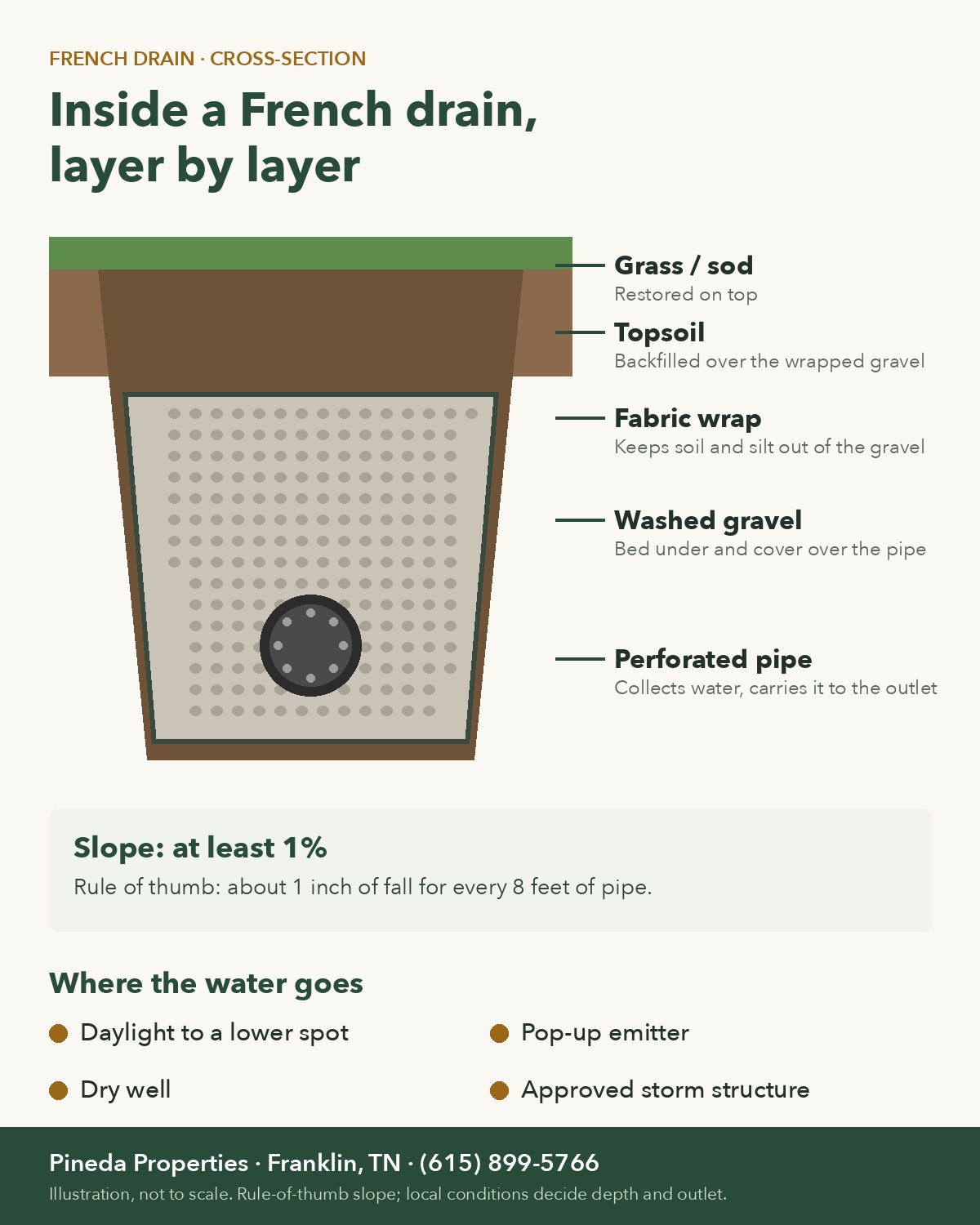
A French drain is a sloped trench lined with fabric, filled with washed gravel, and fitted with a perforated pipe that carries water to an outlet. Here is the build from start to finish.
- Call 811. Tennessee 811 arranges marks for buried utility lines before anyone digs.[5]
- Pick the outlet first. Decide where the water goes: a lower spot, a pop-up emitter, a dry well, or an approved storm structure.
- Mark the route and check the fall. A common rule of thumb is a fall of at least 1%, about 1 inch for every 8 feet of pipe.
- Dig the trench. The trench follows the wet area and keeps a steady fall to the outlet.
- Line it with fabric. Landscape fabric wraps the rock and pipe to keep soil and silt out.
- Add gravel and pipe. A bed of washed gravel goes in, then the perforated pipe, then more gravel on top.
- Wrap and backfill. The fabric folds over the gravel, and topsoil goes back over it.
- Restore the yard. Sod, beds and edging go back so the drain disappears.
- Test it. Run a hose at the high end and watch the water come out at the outlet.
See how we handle this work on our French drain installation page.
DIY French drain vs hiring a pro
A short, shallow line in easy ground can be a weekend DIY job. Long runs, clay, flat yards and tricky outlets are where a pro saves you from digging twice.
DIY can make sense when
- The run is short, like a single downspout line.
- A clear outlet sits downhill from the wet spot.
- No big roots or utility lines cross the route.
- You are fine digging by hand and hauling rock.
Hire a pro when
- Your yard is heavy clay or the run is long.
- The yard is flat and the fall must be set carefully.
- The outlet is near a neighbor, the street or a storm structure.
- Water is reaching your foundation or crawl space.
- You have finished beds, patios or sod to protect.
Count the full DIY cost before you start: tool rental, rock delivery, fabric, pipe and the sod you will need to replace. A drain without enough fall or a good outlet often has to be dug up and done again.
Questions to ask a French drain contractor
Ask where the water will go, how the slope is set, and what the price includes. Clear answers make two bids easy to compare.
- Where will the outlet be, and why there?
- How deep is the trench, and how will you keep the fall to the outlet?
- What pipe, fabric and rock do you use?
- Is the price per foot or a total, and what length did you measure?
- Does the price include putting back sod, beds and edging?
- Who calls 811, and who handles roots or utility lines in the way?
- Will any water head toward a neighbor’s yard or the street?
- Do I need a permit for this project, and who gets it?
A good contractor answers each one in plain words. Pineda prices each drain after a site visit, so your quote is built on your yard, not a guess.
Get a French drain price for your Franklin yard
Pineda Properties installs French drains and grading across Franklin, Brentwood, Spring Hill, Nolensville, Thompson’s Station, College Grove, Fairview and Nashville. Each drain is priced after a site visit.
Get your free estimate Call (615) 899-5766French drain cost questions, answered
How much does a French drain cost per foot?
National price guides put a French drain at about $10 to $65 per linear foot installed. Ware Landscaping in Illinois quotes a tighter $20 to $50 per foot. Clay, depth, slope and the outlet decide where a yard lands in that range.
How much does a 100-foot French drain cost?
LawnStarter prices a 100-foot French drain at about $1,000 to $6,500 nationally. The low end fits easy digging with a nearby outlet. The high end fits clay, deep trenches and a long run to the outlet.
Is a French drain good for clay soil?
Yes, a French drain can work well in clay soil when it carries water to a good outlet. Clay drains slowly, so the drain needs a steady fall and a place where water can run downhill or leave the yard. Clay is also slower to dig, which can raise the price per foot.
What is an alternative to a French drain?
Common alternatives are surface drains such as catch basins and channel drains, buried downspout lines, dry wells and regrading the yard. A surface drain fits water that runs across the top, while a French drain fits ground that stays soggy. Many yards use a mix of both.
What are the disadvantages of a French drain?
A French drain means digging a trench through your lawn or beds, so the yard needs repair afterward. It only works with a steady fall and a good outlet, and a flat yard can make that harder. Buried utilities and tree roots can also limit the route.
Do you need a permit for a French drain?
Some projects need a permit and some do not, depending on the size of the job and where you live. Where a permit is required, LawnStarter lists $58 to $225 for it nationally. For big drainage projects in Franklin or Williamson County, check with the city or county before work starts.
Can a French drain empty into the street or a neighbor’s yard?
Don’t aim French drain water at a neighbor’s yard or the street. Plan an outlet on your own property, such as a lower spot, a pop-up emitter or a dry well, or a tie-in to an approved storm structure. For big projects, check with the city or county first.
Sources
- LawnStarter, “How Much Does a French Drain Cost in 2026?”, updated October 2026
- Glanz Buffat (Louisville, KY), “How Much Does a French Drain Cost?”, April 21, 2025
- Ware Landscaping (Naperville, IL), “How Much Does Yard Drainage Cost in 2026? A Complete Homeowner’s Guide”, undated
- NOAA National Centers for Environmental Information, U.S. Climate Normals 1991–2020, Nashville International Airport (USW00013897)
- Tennessee 811, call before you dig (dial 811)