
Irrigation guide · Franklin and Williamson County
How to Winterize Your Sprinkler System in Franklin, TN: 6 Steps Before the First Freeze
The right week to do it, the six steps, safe air pressure, backflow care and what a pro costs in Middle Tennessee.
Quick answer
In Franklin, winterize your sprinkler system by late October to early November. Nashville’s first 32°F freeze comes on Nov 3 on average, and there is a 10% chance it comes by Oct 22[1]. Shut off the water, set the controller to off or rain mode, drain or blow out the lines, turn the backflow valves to half open (45°), drain the parts above ground, and insulate the backflow preventer.
When to winterize your sprinkler system in Franklin, TN
Winterize between late October and early November. At the very latest, finish before the first hard freeze, which averages Nov 15 at 28°F in Nashville[1].
The dates come from NOAA’s 1991–2020 climate normals for Nashville International Airport[1]. The average first 32°F night is Nov 3. But that is only the middle of the range. In one fall out of ten, the first freeze has already come by Oct 22.
Chance that the first 32°F freeze of fall has happened by each date. Source: NOAA NCEI U.S. Climate Normals 1991–2020, Nashville International Airport (USW00013897).
Why a mild Tennessee winter still cracks pipes
Franklin is in USDA zone 7b, where the coldest winter night averages 5 to 10°F[6]. That is cold enough to freeze any water left in your system.
The parts above ground freeze first: the backflow preventer, exposed pipe and valves. They sit in open air with no soil around them.
In Franklin, the parts of your sprinkler system you can see are the parts that freeze first.
A simple rule for your calendar
Pick a dry weekend in the last week of October or the first days of November. If you hire it out, book in October so the work is done before the first freeze.
How to winterize a sprinkler system in 6 steps
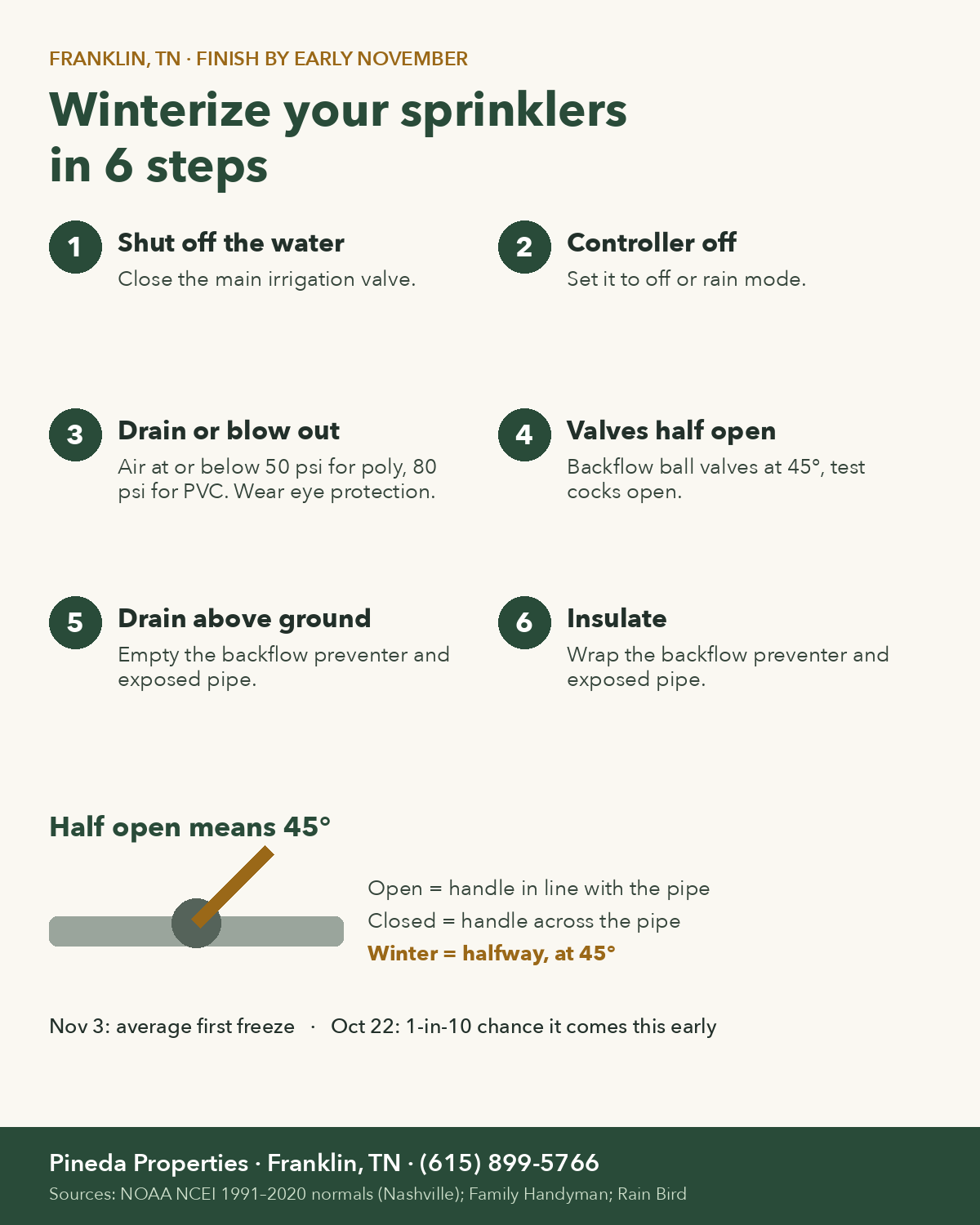
The job has six steps: shut off the water, turn off the controller, empty the lines, set the backflow valves to half open, drain the parts above ground, and insulate what stays exposed. These steps follow Rain Bird’s homeowner guide[2].
- Shut off the water at the main irrigation valve. This is the valve that feeds only your sprinkler system, not the house. Close it all the way.
- Set the controller to off or rain mode. This stops the timer from opening a zone while the lines are empty.
- Drain or blow out the lines. Use your system’s drain valves, or push the water out with compressed air. Keep the air at or below about 50 psi for poly pipe and 80 psi for PVC[3].
- Turn the backflow ball valves to half open (45°). Open the small test cocks too. Family Handyman lists this as its own step: “Turn Your Valves to 45 Degrees”[3].
- Drain the parts above ground. Empty the backflow preventer and any exposed pipe so no water sits where cold air can reach it.
- Insulate the backflow preventer and exposed pipes. Wrap them with pipe insulation or an insulated cover made for backflow devices.
Rain Bird, Hunter and Orbit controllers
The six steps are the same for every brand. Only the controller step changes. Look for an off position or a rain mode on the dial or screen, and check the maker’s manual if you cannot find it.
Drain-down or blowout: pick the method that fits your system
Use a drain-down if your system has drain valves. Use a compressed-air blowout if it has a blowout port and you own a compressor with a pressure regulator. Both methods aim for the same result: no water left in the pipes.
| Drain-down | Compressed-air blowout | |
|---|---|---|
| How it works | Open the drain valves and let water run out of the pipes. | A compressor pushes water out of the lines, one zone at a time. |
| What you need | Access to the drain valves on your system. | An air compressor with a regulator, plus eye protection. |
| Air pressure | None. | At or below about 50 psi for poly pipe, 80 psi for PVC[3]. |
| Main risk | Water can stay where the pipe dips low. | Too much pressure, and compressed air that can injure eyes. |
| Best for | Systems built with drain valves. | Systems with a blowout port and an owner who has the right tools. |
What psi to use for a sprinkler blowout
Set the regulator before you connect the hose. Keep it at or below about 50 psi if your lines are flexible black poly pipe, and at or below about 80 psi for rigid PVC[3]. If you do not know which pipe you have, use the lower number.
How to winterize your backflow preventer
Turn its ball valves to half open (45°), open the test cocks, drain it, and wrap it in insulation. The backflow preventer usually sits above ground, so it is the first part of your system that cold air reaches.
The backflow preventer stops a cross connection between your sprinkler water and your drinking water. Utilities can require it on permanent irrigation. Your water utility sets the rules for it, including how often it needs a test.
What a local utility requires
Milcrofton Utility District, for example, tells its customers: “Permanent lawn irrigation systems … a Reduced Pressure backflow preventer is required to prevent any cross connection between your system and potable water. This device shall be tested annually.”[5]
Rules differ from one utility to the next. Check with the utility named on your water bill for its test schedule and its list of approved testers.
How to insulate it well
Cover the whole device, the exposed pipe below it and the valve handles. Use pipe insulation, an insulated pouch made for backflow preventers, or both. Make sure the cover stays on through wind and rain.
DIY or hire a pro: sprinkler winterization cost in Nashville
Hiring it out costs about $101 on average in the Nashville area, with typical jobs from $50 to $115, according to Angi[4]. Doing it yourself costs your time plus the right tools.
Do it yourself if
Your system has drain valves you can reach, or you own a compressor with a regulator and eye protection. You know where your main irrigation valve and backflow preventer are.
Hire a pro if
You do not own a compressor you trust, you are not sure which pipe you have, or your schedule is full in late October. Ask the pro to cover the backflow preventer and exposed pipe too.
Book early either way
Plan the work for late October to early November. There is a 10% chance of a 32°F night by Oct 22 in Nashville[1].
When you compare quotes, ask what is included: the blowout or drain-down, the backflow valve setting, insulation of exposed parts, and the controller set to off or rain mode. A full job covers all six steps.
See what Pineda Properties does on its irrigation services page.
Keep your pipes whole: 5 winterizing mistakes to skip
Five slips put water and cold in the wrong place: waiting too long, a timer left on, too much air, bare parts above ground, and standing in the line of air. Skip all five.
1. Waiting for the hard freeze
The first 28°F night averages Nov 15, but the first 32°F night averages Nov 3[1]. A 32°F night is enough to freeze water in exposed parts.
2. Leaving the controller on
A timer that still runs can open a zone after you drain it. Set the controller to off or rain mode as step two.
3. Too much air pressure
Stay at or below about 50 psi for poly pipe and 80 psi for PVC[3].
4. Forgetting the parts above ground
The backflow preventer, exposed pipe and valves freeze first. Drain them and insulate them, even after a full blowout.
5. Standing over a sprinkler head
Compressed air can injure eyes. Wear eye protection and stay clear of heads while the air is on[3].
When to turn your sprinklers back on in spring
Start your system after the last freeze. In Nashville the last 32°F night averages Mar 31, and after Apr 16 the chance of another one drops to 10%[1]. Mid-April is the low-risk window for Franklin.
- Remove the insulation and close the test cocks. Check the backflow preventer for cracks before water reaches it.
- Open the valves slowly. Let water fill the lines a little at a time.
- Check every head. Run each zone and look for broken, buried or tilted heads.
- Set the controller. Take it out of off or rain mode and set the schedule for spring.
Spring start-up lines up with planting season. Our Middle Tennessee planting calendar shows what to plant once the freeze risk is behind you.
Get your sprinkler system winterized before the first freeze
Pineda Properties serves Franklin, Brentwood, Spring Hill, Nolensville, Thompson’s Station, College Grove, Fairview and Nashville. Rated 4.8 on Google by 67 homeowners.
Get a free estimate Call (615) 899-5766Sprinkler winterizing questions, answered
Will sprinkler pipes freeze at 30 degrees?
Yes, they can. Water freezes at 32°F, so a 30°F night can freeze water in the parts above ground first: the backflow preventer, exposed pipe and valves. In Nashville the first 32°F night comes on Nov 3 on average, so winterize before then.
How much does it cost to have someone winterize your sprinkler system?
In the Nashville area, sprinkler winterization costs about $101 on average, with typical jobs from $50 to $115, according to Angi. Ask each company whether the price covers the backflow preventer and insulation of exposed parts.
Do you have to winterize your sprinkler system in Tennessee?
Yes. Franklin is in USDA zone 7b, where the coldest winter night averages 5 to 10°F. That is cold enough to freeze water left in the backflow preventer, exposed pipe and valves.
How do you drain an in-ground sprinkler system?
Shut off the water at the main irrigation valve, set the controller to off or rain mode, then open the system’s drain valves and let the water run out. Turn the backflow valves to half open (45°), drain the parts above ground, and insulate the backflow preventer.
How do you winterize a Rain Bird or Hunter sprinkler system?
The steps are the same for any brand: shut off the water, set the controller to off or rain mode, drain or blow out the lines, set the backflow valves to 45°, drain the parts above ground, and insulate. Only the controller buttons differ, so check your controller’s manual for its off or rain setting.
What psi should you use to blow out sprinklers?
Keep the air at or below about 50 psi for flexible poly pipe and about 80 psi for rigid PVC, according to Family Handyman. Wear eye protection and never stand over a sprinkler head while the air is on.
When should you turn your sprinklers back on in spring?
Turn them back on after the last freeze. In Nashville the last 32°F night averages Mar 31, and after Apr 16 there is only a 10% chance of another one. Open the valves slowly, check every head and set the controller.
Sources
- NOAA NCEI, U.S. Climate Normals 1991–2020, Nashville International Airport (USW00013897), freeze probability dates
- Rain Bird, How Do I “Winterize” My Irrigation System, checked November 2026
- Family Handyman, How to Winterize a Sprinkler System, updated September 27, 2023
- Angi, Sprinkler System Winterize or Activate cost in Nashville, TN, checked November 2026
- Milcrofton Utility District, Cross-Connection Control flyer, December 2023
- USDA Agricultural Research Service, 2023 Plant Hardiness Zone Map, checked November 7, 2026